magazine.ltd Salt Lake Citymagazine.ltd Salt Lake City

Welcome

Late October in Salt Lake City means a ballot on the kitchen counter, a few big decisions at City Hall and Halloween lights at the zoo. This newsletter gives you the insights, dates, places and links that make community involvement easy.

At Salt Lake City Magazine Limited, our mission is to give you unbiased information. If you think an article is missing information or important context, contact us.

Weather Outlook

Events

Vibe legend / filter events

Keep any matching vibe checked to include an event.

Thru Oct 30 Red Butte Garden turns into Neverland after dark, and kids get to rescue Peter Pan Kids and family Outdoors Read more Show less

Vibe: Kids and family, Outdoors

Red Butte Garden turns into Neverland after dark, and kids get to rescue Peter Pan

How do families save Peter Pan from Captain Hook in the glowing garden?

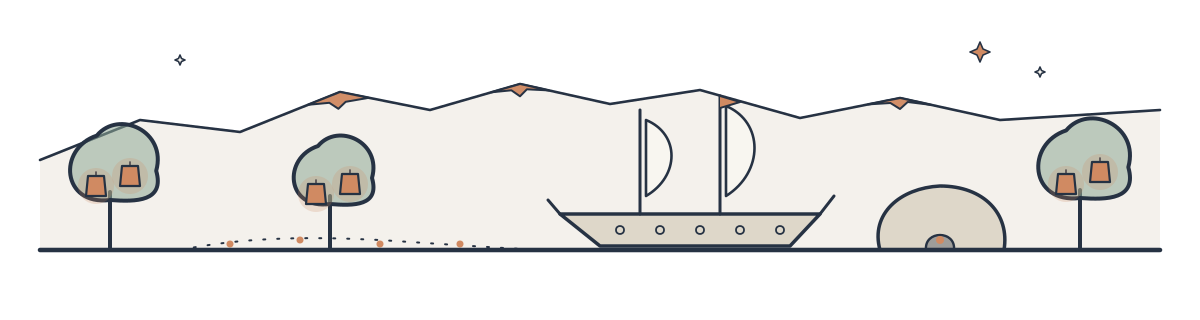
Illustration of Garden After Dark at Red Butte Garden: lanterns hanging in the trees, a dotted path with small lights, a pirate ship and a rock with a glowing cave mouth, and a bright star in the sky.Illustration of Garden After Dark at Red Butte Garden: lanterns hanging in the trees, a dotted path with small lights, a pirate ship and a rock with a glowing cave mouth, and a bright star in the sky.

The story this year: Captain Hook has shrunk Peter Pan and locked him in Skull Rock, and it is up to the kids to save him.

When: Through October 30, 2026. Mon to Thu 6:00 to 8:00 p.m. (last entry 7:00); Fri to Sun 6:00 to 9:00 p.m. (last entry 8:00)

Where: Red Butte Garden, 300 Wakara Way (Map)

Cost: $15 weeknights, $20 weekend nights (public); free for ages 2 and under

Families follow the glowing "Adventures in Neverland" trail through the dark garden collecting pixie dust beads for Tinker Bell, played by Kimberly Frandsen, while Marc Reading's Captain Hook prowls the paths.

Along the way there is a storyteller, Ginger Parkinson; Puppets in the City; a DJ; and, on October 23 and 24, the band Snarlin' Yarns. Warm up with Buzzed Coffee, DonutNV or Zapplz.

Good to know: everyone over 2 needs a ticket, so buy ahead online. For a calmer visit, the Hocus Crocus All-Abilities Hour runs 5:00 to 6:00 p.m. on Saturdays and Sundays.

Costumes are welcome, but guests 14 and older cannot wear masks that cover the eyes. Park in the Williams Building garage at 295 Chipeta Way. Event details

Thru Oct 31 Cross E Ranch packs a corn maze and 30 attractions into one ticket Kids and family Outdoors Read more Show less

Vibe: Kids and family, Outdoors

Cross E Ranch packs a corn maze and 30 attractions into one ticket

How much farm can a family fit into one fall day?

Illustration of a fall farm day at Cross E Ranch: a red barn, a corn maze field tilted to show its paths, a hay wagon stacked with bales, pumpkins and corn stalks.Illustration of a fall farm day at Cross E Ranch: a red barn, a corn maze field tilted to show its paths, a hay wagon stacked with bales, pumpkins and corn stalks.

More than 30 attractions come with one ticket at Cross E Ranch. The headliner is the "Happy Birthday America!" corn maze, cut in mini, medium and mega sizes.

When: Through October 31, 2026, closed Sundays. Mon to Thu 4:00 to 9:00 p.m., Fri 4:00 to 10:00 p.m., Sat 10:00 a.m. to 10:00 p.m.; closes 5:00 p.m. on Halloween

Where: Cross E Ranch, 3500 N 2200 W (Map)

Cost: Adults about $21 to $25 and kids 3 to 11 about $17 to $21, depending on the day; 2 and under free; tickets online only

Around it you'll find:

  • Races: pig racing and duck races
  • Rides: a hay ride and a barrel train
  • Up high: zip lines, a ropes course and a rock wall
  • Bounce and slide: jump pads, slides, rat rollers and hula cows
  • Play: jumbo Jenga, a hay pyramid, corn pits, archery and a Kiddie Korral
  • Downtime: farm animals, photo spots and fire pits

(That is the short version. Catch your breath at a fire pit.) Face painting and pony rides cost extra.

With kids: come Saturday morning, when the early-bird ticket is about $19 from 10:00 to 10:30 a.m., and bring a wagon and good shoes. Picnics are allowed and parking is free. Dogs on a leash are welcome.

For a date night: an evening-only ticket is about $16 after 7:00 p.m. Do the mega maze in the dark, then grab a fire pit.

What to eat and drink: caramel apples from Millie's Sweet Shop, kettle corn and churros from the Grazing Place, apple cider donuts from the Donut Barn, and burgers from the grill.

To drink there is hot cider, an apple cider slushy and hot cocoa; the ranch does not allow alcohol. Pumpkins are sold separately, by weight. Festival details

Thru Oct 31 Wheeler Farm's free pumpkin patch is open through October 31 Outdoors Kids and family Read more Show less

Vibe: Outdoors, Kids and family

Wheeler Farm's free pumpkin patch is open through October 31

Where can you pick a pumpkin and ride a cow train on the same afternoon?

Illustration of Wheeler Farm's Pumpkin Days: pumpkins of different sizes on vines in a fenced pasture, straw bales stacked at the edge of the maze, and a tractor pulling a wagon in the background, with the mountain ridgeline behind.Illustration of Wheeler Farm's Pumpkin Days: pumpkins of different sizes on vines in a fenced pasture, straw bales stacked at the edge of the maze, and a tractor pulling a wagon in the background, with the mountain ridgeline behind.

At Wheeler Historic Farm in Murray, the pumpkin patch is free to walk, and the pumpkins are priced by size. A maze ticket also covers the playland and one ride on a wagon or the cow train.

When: Daily through October 31, 2026. Patch: Mon to Thu 10:00 a.m. to 8:00 p.m., Fri and Sat 9:00 a.m. to 9:00 p.m., Sun 9:00 a.m. to 4:00 p.m. Maze: same, but opens 4:00 p.m. Mon to Thu (10:00 a.m. October 19, 22, 26).

Where: Wheeler Historic Farm, 6351 S 900 E, Murray; the patch is in the North Parking Lot Pasture (Map)

Cost: The patch is free to walk; pumpkins are priced by size. Maze and playland $12 with one wagon or cow train ride, $10 maze only, $10 full ticket on Tuesdays; free for ages 2 and under with a paying caregiver. Extra rides $3.

Wheeler is a 75-acre working farm and public park run by Salt Lake County. The Pumpkin Days maze is built from straw bales. Extra wagon or cow train rides are $3 at the Rosebud Country Store, the Activity Barn or the ticket booth.

Dogs can come too: leashed, well-behaved dogs are welcome in the patch. On Tuesday evenings, food trucks park at the farm.

On weekdays the maze opens after school, so plan an afternoon visit. On Halloween it is open 10:00 a.m. to 4:00 p.m. Pumpkin Days details

Oct 20 On October 20 the City Council votes on what the old Ballpark site becomes Civic Read more Show less

Vibe: Civic

On October 20 the City Council votes on what the old Ballpark site becomes

What would the rezone allow, and what else is on the agenda?

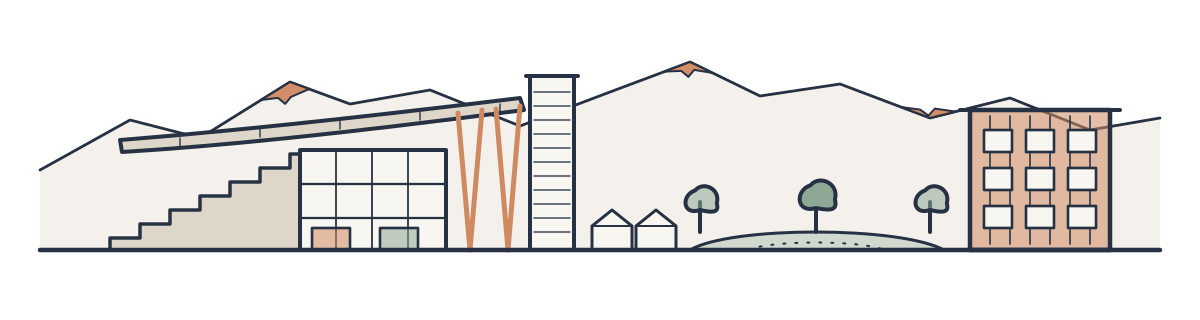
Illustration of the Ballpark NEXT plan for the old Ballpark site: the preserved grandstand under a new sweeping roof held up by angled timber struts, a glass wall with small shop entrances, the old tower kept as a beacon, market tents, a neighborhood field with trees, new apartments with wood siding, and the Wasatch peaks behind.Illustration of the Ballpark NEXT plan for the old Ballpark site: the preserved grandstand under a new sweeping roof held up by angled timber struts, a glass wall with small shop entrances, the old tower kept as a beacon, market tents, a neighborhood field with trees, new apartments with wood siding, and the Wasatch peaks behind.

This is the meeting where the City Council decides what the old Ballpark site becomes.

When: Tuesday, October 20, 2026, 7:00 p.m.

Where: City Council Chambers, Room 315, City & County Building, 451 S State St (Map), or online (details on the council agendas page)

On the agenda for a vote: rezoning the former stadium property near 1300 South and West Temple to mixed use, mostly MU-8 with some MU-5, so the land can be redeveloped along the Ballpark NEXT plan that the City's redevelopment agency adopted in December 2025.

The Council also plans to vote on whether to ban new community correctional facilities and jails as a conditional use citywide; state and federal property is exempt.

Earlier in the evening there are public hearings on five grant applications, including home repairs for older adults and an all-abilities outdoor recreation project at Allen Park, and on how the City should spend next year's federal housing and community development money.

How to speak: arrive by 7:00 and fill out a comment card. The general comment period is one hour, two minutes per person, and registration closes at 7:30 p.m. Can't make it? Call the 24-hour comment line at 801-535-7654 or email council.comments@slc.gov.

Ballpark rezone details. Read the full agenda

October 21 and October 28 The Natural History Museum stays open late two Wednesdays for Spooky Science Kids and family Educational Read more Show less

Vibe: Kids and family, Educational

The Natural History Museum stays open late two Wednesdays for Spooky Science

How do you build a spider bot, and what is a Ghost Moth Ball?

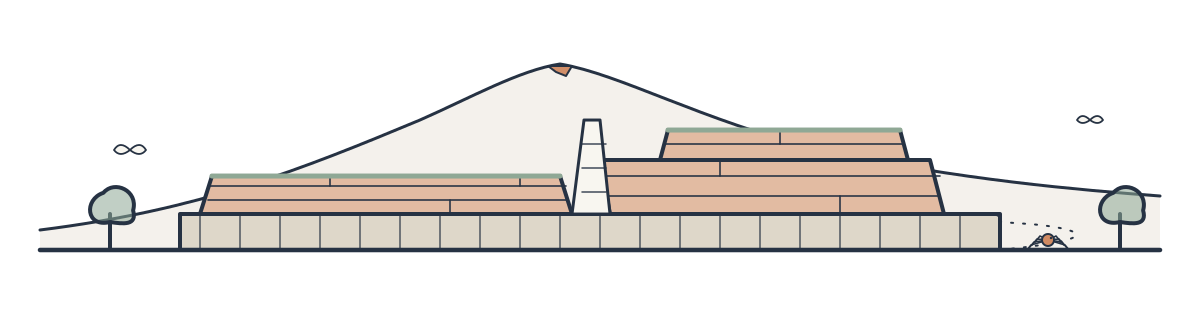
Illustration of the Natural History Museum of Utah: long copper-banded terraces stepping up a steep foothill on a concrete base, a tall glass slot between the wings, a switchback path, with two moths and a small spider robot as accents.Illustration of the Natural History Museum of Utah: long copper-banded terraces stepping up a steep foothill on a concrete base, a tall glass slot between the wings, a switchback path, with two moths and a small spider robot as accents.

On two October Wednesdays the museum stays open late for a family-friendly Spooky Science Night, with scientific surprises for kids and families of all ages.

When: Wednesdays, October 21 and 28, 2026, 5:00 to 9:00 p.m.

Where: Natural History Museum of Utah, 301 Wakara Way (Map)

All of it is included with admission:

  • build a spider bot or a floating ghost
  • chase a scavenger hunt through the galleries
  • dance at the Ghost Moth Ball

Costumes are encouraged, and the museum asks you to prebook tickets: Book tickets

October 22 and October 29 The Track Club's Thursday runs climb out of the dark above the city Outdoors Read more Show less

Vibe: Outdoors

The Track Club's Thursday runs climb out of the dark above the city

How far, how steep, and how fast do you have to be?

Illustration of a dawn trail run: a dotted switchback trail climbing the foothills with glowing headlamp dots, the sun rising over the Wasatch, and the city grid below.Illustration of a dawn trail run: a dotted switchback trail climbing the foothills with glowing headlamp dots, the sun rising over the Wasatch, and the city grid below.

It is still dark at 7:00 when the group gathers, headlamps on, breath showing. Then the pack heads uphill and the city drops away behind you.

When: Thursdays at 7:00 a.m., October 22 and 29, 2026

Where: Oct 22 at 500 North and Columbus Street (Map); Oct 29 at the Bonneville Shoreline Trail lot across from Hogle Zoo on Sunnyside Ave (Map)

Cost: Free; all paces; dogs welcome

On October 22 the route climbs from the Capitol Hill neighborhood into Hells Canyon and along the Provo Shoreline; on October 29 it starts at the Bonneville Shoreline Trail lot across from the zoo and covers about 6.9 miles with about 560 feet of climbing.

Somewhere on the climb the sun comes over the Wasatch and the valley lights go out below.

The club says every pace is welcome, so nobody gets left at the trailhead, and dogs come along too. Bring trail shoes and a headlamp; when the trails ice up, the club recommends traction like Yaktrax.

Regulars sign a waiver, and there are no restrooms at the start. Run details

  • MapMyRun, 11088.4 m route in Canyon Rim, Utah (linked from the club's Oct 29 listing; route data read Oct 16: 11,088.4 m, ascent 171.5 m, start 40.7506, -111.8115 by the zoo lot) (retrieved 2026-10-16)
  • Salt Lake City Track Club, Weekly Runs (re-checked Oct 16: free, all levels, dog-friendly, trail shoes, headlamp, Yaktrax, Oct 22 Hells Canyon and Provo Shoreline from 500 N and Columbus St, Oct 29 BST trailhead across from Hogle Zoo, waiver for regulars, no facilities)
Oct 22 Ceramic artist Andrea Cárdenas talks about memory and migration at Material on October 22 Educational Read more Show less

Vibe: Educational

Ceramic artist Andrea Cárdenas talks about memory and migration at Material on October 22

What does a family carry when it moves, and how does clay hold it?

Illustration of the Material gallery interior: an exposed round duct along the ceiling, handmade clay vessels and bowls on two floating shelves, a sectional roll-up door with a row of windows, a large clay vessel on a tapered pedestal, and a blank framed work.Illustration of the Material gallery interior: an exposed round duct along the ceiling, handmade clay vessels and bowls on two floating shelves, a sectional roll-up door with a row of windows, a large clay vessel on a tapered pedestal, and a blank framed work.

Material, the artist-led gallery and shop on South West Temple, is a good place to see what people in this valley are making right now, and on October 22 you can hear one of them explain her work in person.

When: Thursday, October 22, 2026, 6:00 to 7:30 p.m.; artist talk 6:30 to 7:00 p.m.

Where: Material, 2970 S West Temple (Map)

Andrea Cárdenas, the ceramic artist behind Joy Clay Works, grew up in México and trained in architecture and interior design before she turned to clay.

Her handmade pieces deal with memory, cultural identity, migration, motherhood and ancestral knowledge, the things a family carries with it when it moves.

She talks about that work from 6:30 to 7:00 p.m. Before and after, wander the gallery and The Shop, Material's store for work by local makers, where you can buy a piece to take home.

The gallery is otherwise open during events and by appointment, so a night like this is the easy way in. See the Material events page.

  • Material, Events and event flyer (Oct 12) (retrieved 2026-10-12)
  • joyclayworks site, about page (Oct 16: Mexican ceramic artist, architecture and interior design background, themes of memory, cultural identity, migration, motherhood, ancestral knowledge)
Nightly, October 22 to October 30 Hogle Zoo glows after dark for Hogle Halloween, every night October 22 to 30 Kids and family Outdoors Read more Show less

Vibe: Kids and family, Outdoors

Hogle Zoo glows after dark for Hogle Halloween, every night October 22 to 30

What is the zoo like when the animals are asleep?

Illustration of Hogle Halloween: A Boo Lights Experience at Utah's Hogle Zoo after dark: a glowing wire-light lion, a pumpkin-headed scarecrow lantern and an owl-shaped lantern along a path lined with low path lights, under a string of lights with the mountain ridgeline behind.Illustration of Hogle Halloween: A Boo Lights Experience at Utah's Hogle Zoo after dark: a glowing wire-light lion, a pumpkin-headed scarecrow lantern and an owl-shaped lantern along a path lined with low path lights, under a string of lights with the mountain ridgeline behind.

Once the animals are asleep, the zoo lights up. Hogle Halloween: A Boo Lights Experience fills the paths with glowing displays, and kids in costume can meet Spiderella, take a nighttime ride on the Eccles Express and catch Dr. Frankenstein's puppet show at 8:00.

When: Nightly, Thursday, October 22, to Friday, October 30, 2026, 6:30 to 9:30 p.m.

Where: Utah's Hogle Zoo, 2600 Sunnyside Ave (Map)

Cost: $24.95 ages 13 and up, $19.95 ages 3 to 12, free for ages 2 and under; members save $2. Train and carousel rides are $3.50. Buy tickets

Most habitats are closed or dark, so come for the lights, not the animals. The zoo suggests at least 90 minutes. It runs rain or shine, and costumes are welcome, but no full-face masks or prop weapons. Event details

October 23, October 30, November 6, November 13 and November 20 Count birds on the Jordan River with Tracy Aviary every Friday Outdoors Educational Date night Read more Show less

Vibe: Outdoors, Educational, Date night

Count birds on the Jordan River with Tracy Aviary every Friday

Who uses the river in fall, and how can you help count them?

Illustration of a fall morning on the Jordan River: a great blue heron standing in the shallows, ducks on the water, cottonwoods and cattails on the banks, migrating birds overhead, and binoculars resting on a trail post.Illustration of a fall morning on the Jordan River: a great blue heron standing in the shallows, ducks on the water, cottonwoods and cattails on the banks, migrating birds overhead, and binoculars resting on a trail post.

Walk the trails along the Jordan River with Tracy Aviary's conservation team and help count every bird you see or hear.

When: Fridays, 8:00 to 10:00 a.m.: October 23 and 30, November 6, 13 and 20, 2026

Where: Tracy Aviary Nature Center at Pia Okwai, 3310 S 1000 W, South Salt Lake (Map)

Cost: The Nature Center is free to visit

The aviary describes the Nature Center as an "outdoor oasis dedicated to the wildlife of the Pia Okwai (Jordan River)," and it sits on county land in James Madison Park that the county leases to the aviary.

Fall is when ducks and other migrants pass through, so each Friday's count adds to the aviary's record of who uses the river.

What to bring: the aviary says to "come prepared for an outdoor experience." Dress for a cold morning, wear shoes that can get muddy, and bring binoculars if you have them, plus water.

How to go: drive or bike to the Nature Center off 1000 West, or walk in on the Jordan River Parkway trail. Arrive a few minutes before 8. Event details

Oct 23 Trick-or-treat through Conservation Garden Park after dark on October 23 Outdoors Kids and family Read more Show less

Vibe: Outdoors, Kids and family

Trick-or-treat through Conservation Garden Park after dark on October 23

What does a water-wise garden look like on Halloween night?

Illustration of Halloween at Conservation Garden Park at dusk: carved pumpkins glowing on a low stone wall beside a flagstone path, among ornamental grasses, a yucca and rounded shrubs, with first stars over the ridgeline.Illustration of Halloween at Conservation Garden Park at dusk: carved pumpkins glowing on a low stone wall beside a flagstone path, among ornamental grasses, a yucca and rounded shrubs, with first stars over the ridgeline.

For one night, Conservation Garden Park in West Jordan stays open from dusk to dark for trick-or-treating, pumpkin voting and a dog costume contest. Tickets are free, but you need one.

When: Friday, October 23, 2026, 5:00 to 8:00 p.m.

Where: Conservation Garden Park, 8275 S 1300 W, West Jordan (Map)

Cost: Free; a free ticket is required. Get free tickets

The garden is run by the Jordan Valley Water Conservancy District, and it tests more than 1,000 water-wise plants. On October 23, kids trick-or-treat along the decorated paths, and everyone can vote for their favorite community-carved pumpkins.

Bring the dog in costume. To enter the contest, your dog poses for an instant photo. Guests vote, and the winners are announced online. Parking is free.

Can't make Friday? The garden stays decorated through October 31, with a free Spooky Plant Hunt and Ghostly Garden Bingo, during garden hours: Monday to Saturday, 8:00 a.m. to 6:30 p.m. Event details

Oct 24 October 24 is the last outdoor Saturday at the Downtown Farmers Market Outdoors Kids and family Date night Read more Show less

Vibe: Outdoors, Kids and family, Date night

October 24 is the last outdoor Saturday at the Downtown Farmers Market

Every vendor makes it within 250 miles. What can you find there that the store does not carry?

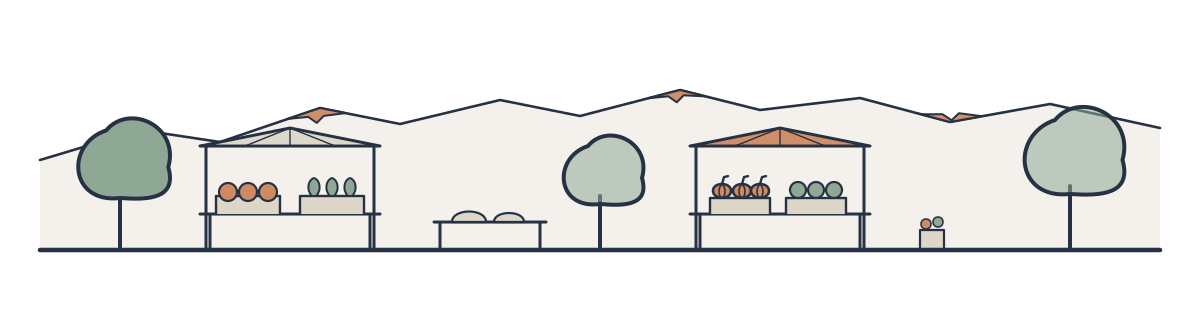
Illustration of the Downtown Farmers Market: two canopy stalls with crates of squash, peppers, pumpkins and greens, a bread table and a small flower bucket, under big shade trees with the Wasatch behind.Illustration of the Downtown Farmers Market: two canopy stalls with crates of squash, peppers, pumpkins and greens, a bread table and a small flower bucket, under big shade trees with the Wasatch behind.

October 24 is the last Saturday of the season in Pioneer Park, and the last chance this year to buy outdoors from the people who grew, raised or baked it.

When: Saturday, October 24, 2026, 8:00 a.m. to 2:00 p.m. (last summer Saturday)

Where: Pioneer Park, 350 S 300 W (Map)

Cost: Free to walk in; vendors set their own prices

About 300 farmers, ranchers, cooks and makers have set up here this summer, and every one of them produces within 250 miles of the market, the market's director told the Tribune.

That rule is why the stalls look nothing like a grocery aisle.

Start with a cup at Santa Backyard Coffee, where Marisa Martinez, a former hair stylist, makes her Café de Olla the traditional way, stirred in a clay pot with espresso, star anise, cinnamon, clove, milk and piloncillo, a Mexican rock sugar.

Then wander to the produce stalls for something you will not find at the store, like edible flowers or pea shoots from the market's own season list.

Past those two stops there is plenty more to find: local lamb and honey, bread fermented for about 20 hours, and this year's new lunch stands, from Salvadoran pupusas to Thai street food.

It was a hard year for Utah fruit, since April frosts wiped out most tree fruit, and the growers who made it to market adapted.

The park itself is under construction this year. The City closed its north half for the work, and the market's vendors were reconfigured around it.

The south end has stayed open for the market, KSL reported, and the park's grand reopening is set for November 13.

Getting there: TRAX stops at Arena and Planetarium are a short walk away. Parking at The Gateway is free for the first hour, then $3.50 an hour, and northbound 400 West next to the park is closed during market hours.

After October 24 the market moves indoors for winter: Saturdays from November 14, 10:00 a.m. to 2:00 p.m., at 209 E 500 S, the former Leonardo building on Library Square. Market details

Oct 24 A sensory-friendly Halloween for neurodivergent kids at The Gateway on October 24 Kids and family Read more Show less

Vibe: Kids and family

A sensory-friendly Halloween for neurodivergent kids at The Gateway on October 24

What if trick-or-treating were built around your child's needs?

Illustration of a calm sensory corner for A Halloween for Every Brain: a soft floor cushion with noise-canceling headphones resting on it, a basket of fidget toys, a fabric trick-or-treat bag and a weighted lap pad on a rug.Illustration of a calm sensory corner for A Halloween for Every Brain: a soft floor cushion with noise-canceling headphones resting on it, a basket of fidget toys, a fabric trick-or-treat bag and a weighted lap pad on a rug.

A Halloween for Every Brain brings trick-or-treating to The Gateway on Saturday, October 24, set up for neurodivergent children and their families. It is free, but you need to reserve a spot.

When: Saturday, October 24, 2026, 11:00 a.m. to 7:00 p.m.

Where: The Gateway, along 400 West and 200 South, downtown (Map)

Cost: Free; reserve a spot ahead. Reserve a free spot

The idea is simple: instead of asking neurodivergent kids to adapt to Halloween, build a Halloween that adapts to them. Everyone is invited.

Local small businesses hand out candy, toys and sensory items. Kids can dance in the music area or take a break in a calm sensory area, and families can use noise-canceling headphones, weighted vests and fidgets.

Parents will also find one-on-one behavior support, free autism screeners and information about local services. Skill Builders ABA is the organizer on the registration page. The Gateway has direct access to public transit. Event details

Oct 24 Epic Brewing hosts an hour with adoptable dogs on October 24 Date night Read more Show less

Vibe: Date night

Epic Brewing hosts an hour with adoptable dogs on October 24

Who is looking for a home at Pints & Pups?

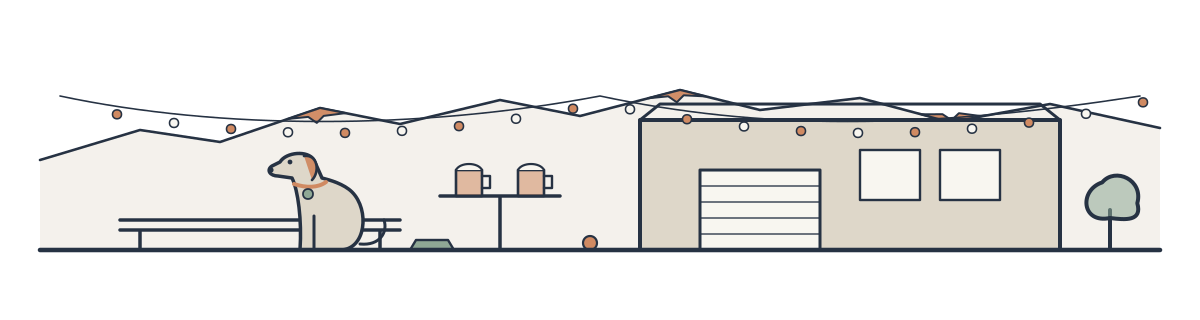
Illustration of a dog social at a taproom: a sitting dog with a collar and round tag, a water bowl and a ball, a long bench, a high table with two mugs, string lights and a brewery building with a roll-up door.Illustration of a dog social at a taproom: a sitting dog with a collar and round tag, a water bowl and a ball, a long bench, a high table with two mugs, string lights and a brewery building with a roll-up door.

For one hour on a Saturday afternoon, Epic's taproom turns into a dog playground, and every dog in it is looking for a home.

When: Saturday, October 24, 2026, 4:00 to 5:00 p.m.

Where: Epic Brewing, 825 S State St (Map)

Cost: Not listed on Epic's event page; a portion of proceeds goes to the Humane Society

Epic calls it a dog social: adoptable pups to play with, a beer in your hand, and a portion of the proceeds going to the Humane Society.

If you've been thinking about adopting, this is a low-pressure way to meet a few dogs; if you haven't, it's still an hour of puppies.

Make it a date: show up at 4:00 for the pups, then stay for dinner on State Street. Event details

Oct 25 Free Pilates in Donner Trail Park on October 25 Outdoors Read more Show less

Vibe: Outdoors

Free Pilates in Donner Trail Park on October 25

Where can you try Pilates for free, with a view of the valley?

Illustration of Pilates in the Park: three exercise mats on a lawn with a rolled mat, a Pilates ring and water bottles, looking out over the city on the valley floor to a low far ridge.Illustration of Pilates in the Park: three exercise mats on a lawn with a rolled mat, a Pilates ring and water bottles, looking out over the city on the valley floor to a low far ridge.

Every Sunday through October, Salt Lake City runs a free, one-hour mat Pilates class in Donner Trail Park on the east bench. It is for all levels, and you do not need to sign up.

When: Sunday, October 25, 2026, 9:00 to 10:00 a.m. (the last Sunday of the August to October series)

Where: Donner Trail Park, 2905 E Kennedy Dr (Map)

Cost: Free; no registration

Bring a mat and a water bottle. Get there a few minutes early to set up, because everyone signs a liability waiver before class starts.

The City finished rebuilding the park this fall, with new playgrounds, a walking path and public art. The park is known for its views of the city and the mountains.

Street parking around the park is free. Class is canceled in bad weather; the City posts updates on its Facebook event page. Event details

Oct 25 Free dog training class in Memory Grove Park on October 25 Outdoors Educational Read more Show less

Vibe: Outdoors, Educational

Free dog training class in Memory Grove Park on October 25

Can a free two-hour class help your dog listen better?

Illustration of a free dog training class in a fall park: a dog sitting on the grass, a leash looped over a post, three training cones, a treat pouch and a water bowl among autumn trees, with the mountain ridgeline behind.Illustration of a free dog training class in a fall park: a dog sitting on the grass, a leash looped over a post, three training cones, a treat pouch and a water bowl among autumn trees, with the mountain ridgeline behind.

Salt Lake City Public Lands runs a free dog training class in Memory Grove Park on Sunday mornings in October, and October 25 is the last one. A professional trainer covers basic obedience, behavior tips and time around other dogs.

When: Sunday, October 25, 2026, 10:00 a.m. to 12:00 p.m. (the last Sunday of the October series)

Where: Memory Grove Park, 300 N Canyon Rd (Map)

Cost: Free

A professional trainer leads it (@barktobasicsllc on Instagram). Your dog does not need any past training. It does need its vaccinations, so puppies can come once they have all their shots.

Bring a leash, a harness, water and high-value treats, the kind your dog will work for. The City asks owners of reactive dogs to leave them at home.

Bad weather can cancel class, so check the City's Facebook event page that morning. Event details

Oct 31 Boo at the Zoo: daylight trick-or-treating for little kids at Hogle Zoo Kids and family Outdoors Read more Show less

Vibe: Kids and family, Outdoors

Boo at the Zoo: daylight trick-or-treating for little kids at Hogle Zoo

Why does daylight trick-or-treating suit toddlers?

Illustration of Boo at the Zoo: a treat table with pumpkins, a candy bucket and a treat bag, and beyond a fence a giraffe standing in its yard near a barn.Illustration of Boo at the Zoo: a treat table with pumpkins, a candy bucket and a treat bag, and beyond a fence a giraffe standing in its yard near a barn.

If your kids are too little for a night of door-knocking, this is Halloween on your schedule: daylight and treat stations throughout the zoo.

When: Saturday, October 31, 2026, 9:00 a.m. to 3:00 p.m.

Where: Utah's Hogle Zoo, 2600 Sunnyside Ave (Map)

Cost: Included with zoo admission or membership

Put them in costume, bring your own bag or bucket, and trick-or-treat around the zoo from 9:00 to 3:00, with treats handed out while supplies last, so earlier is better. It happens rain or shine.

Costume rules for grown-ups and kids: no full-face masks and no costume weapons. Nap time is built in, too: go in the morning, eat lunch at the zoo, and be home before the evening rush. Event details

Nov 1 Celebrate Dia de Muertos at Centro Civico Mexicano on November 1 Kids and family Music and shows Date night Read more Show less

Vibe: Kids and family, Music and shows, Date night

Celebrate Dia de Muertos at Centro Civico Mexicano on November 1

What does a Day of the Dead celebration look like in Salt Lake City?

Illustration of a Dia de Muertos ofrenda: three draped tiers with marigolds and lit candles and a sugar skull decorated with flowers on top, under a string of papel picado with plain cut shapes, with monarch butterflies in the air.Illustration of a Dia de Muertos ofrenda: three draped tiers with marigolds and lit candles and a sugar skull decorated with flowers on top, under a string of papel picado with plain cut shapes, with monarch butterflies in the air.

On Sunday, November 1, Centro Civico Mexicano holds its Dia de Muertos celebration, with food, folk dances, crafts, music and a Catrina parade. There is also an activity with real monarch butterflies.

When: Sunday, November 1, 2026, 1:00 to 6:00 p.m.

Where: Centro Civico Mexicano, 155 S 600 W (Map)

Cost: RSVP online. RSVP

Mexican immigrants founded Centro Civico Mexicano in 1935, and it is the oldest Hispanic nonprofit in Utah. Today it serves more than 10,000 people a year with free or low-cost cultural programs.

Plan to stay a while: eat, watch the dancers, make a craft and find a spot for the parade. The page is in Spanish and English. Event details

Nov 10 November 10 hearings: e-bikes on city trails and more homes on single-family streets Civic Read more Show less

Vibe: Civic

November 10 hearings: e-bikes on city trails and more homes on single-family streets

Where should e-bikes ride, and what could be built next door?

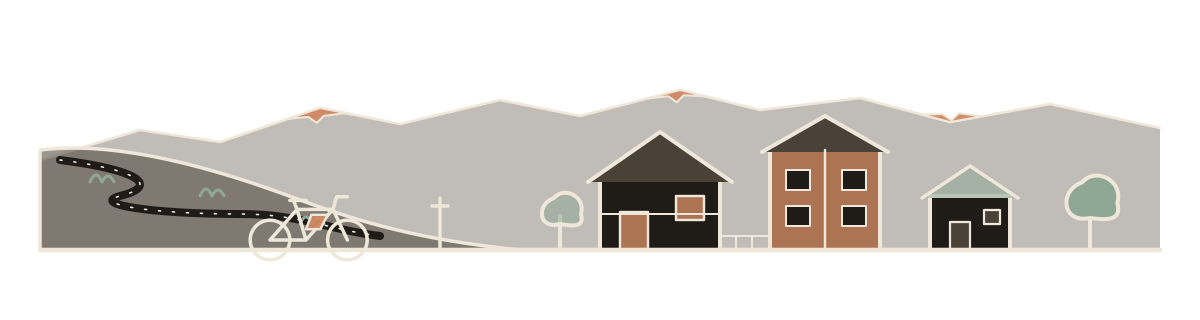
Illustration of the two proposals on the Nov. 10 hearing agenda: a parked e-bike with no rider at the foot of a switchback foothill trail, and a single-family street where a bungalow sits beside a new two-unit home and a small cottage.Illustration of the two proposals on the Nov. 10 hearing agenda: a parked e-bike with no rider at the foot of a switchback foothill trail, and a single-family street where a bungalow sits beside a new two-unit home and a small cottage.

Ride an e-bike on the Jordan River Parkway? Wonder what could be built next door? Both questions go to a City Council hearing on November 10.

When: Tuesday, November 10, 2026, 7:00 p.m.

Where: City Council Chambers, 451 S State St (Map), or online

E-bikes: new rules would set where electric bikes and similar devices can go on city trails and paved paths, trail by trail. A vote could come November 17.

Housing: "Expanding Housing Options" would change height, setback and lot rules in most single-family zones and allow small homes, duplexes and up to fourplexes on smaller lots without a special review. A vote is expected December 1.

To speak, sign up at the hearing in person or online, or email council.comments@slc.gov.

Elections (Tuesday, November 3)

Your ballot was mailed October 13; here is how to get it counted by November 3

It is probably on your counter already. How do you make sure it counts?

Illustration of a mail ballot: a blank stamped envelope follows a dotted path to a sturdy county drop box, with the Utah State Capitol's colonnade and dome on the right.Illustration of a mail ballot: a blank stamped envelope follows a dotted path to a sturdy county drop box, with the Utah State Capitol's colonnade and dome on the right.

Your ballot was mailed on October 13, so it is probably already at home. Here is how to get it counted.

Step 1. Check that you're registered and see your ballot. Look yourself up with the Utah voter lookup to confirm your registration and address. To see every race and question on your ballot, use the state ballot lookup

Step 2. If you're not registered, or moved. Register or update your address on the state registration page by 5:00 p.m. Friday, October 23, to get a ballot in the mail. Need a replacement ballot? Request it by 5:00 p.m. Tuesday, October 27.

After that you can still register and vote in person at any vote center, including on Election Day, with two forms of ID that show your name and where you live.

Step 3. Fill it in and sign the envelope. Mark your choices, put the ballot in the return envelope, and sign the back. An unsigned envelope can't be counted.

Step 4. Return it by 8:00 p.m. on Tuesday, November 3. New this year: a mailed ballot must reach the county clerk by 8:00 p.m. on Election Day, and a postmark no longer counts. In the last week, use a drop box.
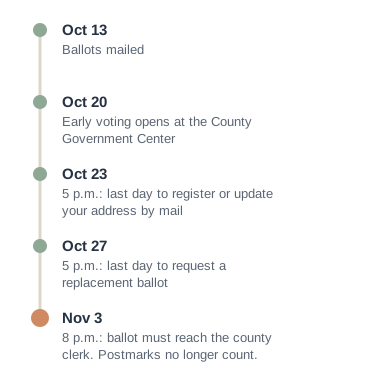
Timeline from ballot mailed October 13 to the 8 p.m. return deadline on November 3: early voting opens October 20, register by October 23, request a replacement by October 27.Timeline from ballot mailed October 13 to the 8 p.m. return deadline on November 3: early voting opens October 20, register by October 23, request a replacement by October 27.
Key dates for the November 3 election. A mailed ballot must reach the county clerk by 8 p.m. on Election Day; a postmark no longer counts. Chart: Salt Lake City Magazine Limited.

Drop boxes in Salt Lake City:

  • Anderson-Foothill Library, 1135 S 2100 E (Map)
  • River's Bend Senior Center, 1300 W 300 N (Map)
  • Salt Lake City Library, 420 S 200 E (Map)
  • Salt Lake County Government Center, 2001 S State St (Map)

See all drop box locations

Step 5. Track your ballot. Sign up for BallotTrax for a text or email when your ballot is mailed, received and counted.

Prefer to vote in person? Early voting runs at two places:

  • County Government Center, 2001 S State St: October 20 to 23 and October 26 to 30, 8:00 a.m. to 5:00 p.m., plus Saturday, October 31, 10:00 a.m. to 2:00 p.m.
  • The Marriott Library, 295 S 1500 E (Map), is open for early voting October 27 to 30, 3:00 to 7:00 p.m. Early voting details

On Election Day, vote centers in the city are open 7:00 a.m. to 8:00 p.m.:

  • Glendale Library, 1375 Concord St (Map)
  • Hogle Zoo, Rendezoo Room, 2600 Sunnyside Ave (Map)
  • Marriott Library, Gould Auditorium, 295 S 1500 E (Map)
  • Northwest Community Center, 1300 W 300 N (Map)
  • County Government Center cafeteria, 2001 S State St (Map)
  • Salt Lake City Public Library, 210 E 400 S (Map)
  • Sugar House Garden Center, 1602 E 2100 S (Map)
  • County Park Operations, 6332 Airport Rd (Map)

See all vote centers

What to bring in person: one current photo ID that shows your name and address, such as:

  • a Utah driver license or state ID card
  • a U.S. passport
  • a military ID
  • a Utah concealed carry permit
  • a tribal ID card, with or without a photo

No photo ID with your address? Bring two documents that together show your name and where you live, for example:

  • a utility bill dated in the last 90 days plus your Social Security card
  • a bank statement plus a current Utah vehicle registration

A recent paycheck or government check, a signed lease or mortgage document, a Medicaid, Medicare or EBT card, a student or employee ID, or a birth certificate also count toward the two. See the full list of accepted ID

What's on your ballot

  • a new U.S. House seat
  • the County Council and four county offices
  • your state senator and state representative
  • school board
  • a $128 million county parks bond
  • two changes to the Utah Constitution
  • judges up for retention

Why returning early helps: at a February 2025 County Council briefing, County Clerk Lannie Chapman said her office received 101,000 mail ballots and 15,000 provisional ballots on Election Day alone in the prior election.

She said each provisional ballot takes a trained worker 5 to 10 minutes to process.

A court-drawn map gives Salt Lake County its own U.S. House seat, and five candidates want it

The new 1st District centers on the county. Who is running, and who is paying for their campaigns?
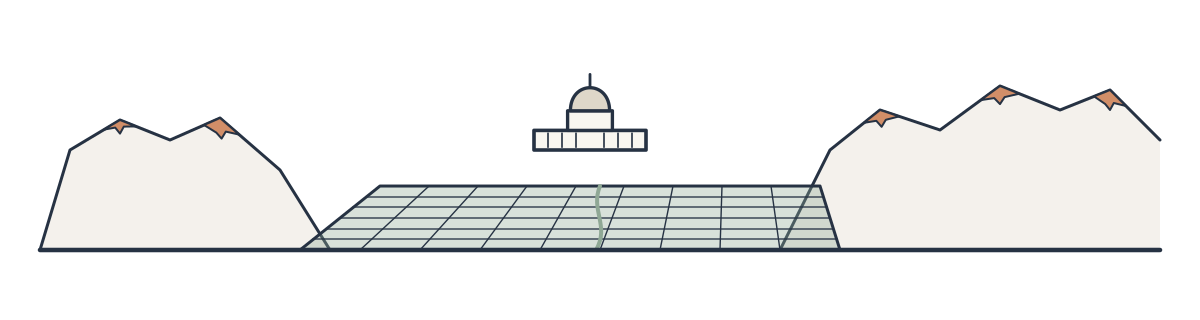
Illustration of the Salt Lake Valley as a gridded floor between the Oquirrh Mountains on the west and the Wasatch on the east, with a creek line and a small U.S. Capitol dome above it.Illustration of the Salt Lake Valley as a gridded floor between the Oquirrh Mountains on the west and the Wasatch on the east, with a creek line and a small U.S. Capitol dome above it.

For years, Salt Lake City was split among congressional districts that reached deep into rural Utah. After courts ruled the old map unlawfully gerrymandered and chose a new one, the 1st District now centers on Salt Lake County.

The winner speaks for the county in Washington on costs you feel, from housing to groceries to water for the Great Salt Lake. The Tribune reports the district favors the Democratic nominee. Five people are running for the two-year term; one is a write-in.
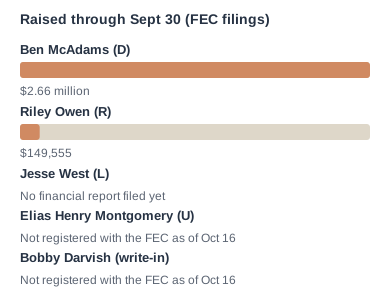
Bar chart: Ben McAdams raised $2.66 million and Riley Owen raised $149,555 through September 30. Jesse West has filed no financial report; Elias Henry Montgomery and Bobby Darvish were not registered with the FEC as of October 16.Bar chart: Ben McAdams raised $2.66 million and Riley Owen raised $149,555 through September 30. Jesse West has filed no financial report; Elias Henry Montgomery and Bobby Darvish were not registered with the FEC as of October 16.
Money raised for the 2026 cycle through September 30, from Federal Election Commission (FEC, the federal agency that tracks campaign money) filings. Owen's total includes a $30,000 loan from the candidate, since repaid. D Democrat, R Republican, L Libertarian, U unaffiliated. Chart: Salt Lake City Magazine Limited.

What this office does

Your representative writes and votes on federal laws, from tax rates and Social Security to veterans' care and national parks. Each one serves a single district for two years, then faces voters again.

The daily work includes introducing bills, offering amendments and sitting on the committees that shape legislation before it reaches a vote.

What they'd do in office

  • He told the Tribune he has spent five years since Congress writing housing policy with cities for walkable, affordable homes near transit. His campaign site adds increasing housing supply, cutting red tape and expanding opportunities for first-time homebuyers.

  • A May 2026 Brookings report he co-wrote proposes building homes on underused Postal Service land while keeping postal operations running, up to 237,000 homes nationwide. It names the post office at 1953 South 1100 East in Sugar House as one candidate site.

  • go after anti-competitive practices he blames for grocery, gas and health care prices
  • He told the Tribune he would invest in conservation and is "working on legislation to bring private dollars to help pay for it," because the private investment driving Utah's growth "can also help secure the water it depends on."

  • oppose the tariffs and the war with Iran that he says are raising costs

Donors

  • Raised: $2,657,115.81
  • Largest committee gifts, July to September: $5,000 each from 11 committees, among them the National Association of Realtors PAC, the International Union of Operating Engineers, the AICPA and Edward Jones PAC
  • Source: FEC filings, cycle through September 30

Record

County minutes from December 2018 record his resignation as county mayor after he won a seat in Congress.

In the state Voter Information Pamphlet he points to early childhood education and Medicaid expansion as mayor, and Great Salt Lake and public lands work in Congress. Since then, the Tribune reports, he has consulted on housing.

What they'd do in office

  • push to get big investors out of single-family homes
  • His campaign site says he would make federal funding for localities conditional on "common-sense zoning reform." In the Tribune questionnaire his examples were reduced minimum lot sizes and allowing accessory dwelling units.

  • His campaign site specifies expanded tax credits for businesses that offer six weeks of paid maternity leave.

  • He told the Tribune he would lease water rights from willing agricultural users, with payment tied to measured water that reaches the lake. He would also remove water-hungry invasive plants like phragmites and make new development pay its own water costs.

  • His campaign site says he would sponsor legislation to end stock trading by members of Congress and staffers, and fight for a constitutional amendment overturning Citizens United and "establishing term limits of 6 for representatives and 3 for senators."

Donors

  • Raised: $149,554.93, including a $30,000 loan from the candidate, since repaid
  • Top donors: Waging Peace, $4,000 (political committee); Kristin Andrus, $3,500 (July to September); Jeremy Andrus, $3,500 (July to September)
  • Source: FEC filings, cycle through September 30

Record

He co-founded the wildlife conservation foundation Sentala, he writes in the pamphlet; the Tribune reports he was a White House policy analyst in the first Trump administration.

He told the Tribune he feels the cost of housing himself, as a renter. He takes no corporate PAC money.

What they'd do in office

  • His site lists how: discourage large-scale institutional purchases of single-family homes, legalize "missing-middle" housing like duplexes and townhomes, require every spending item to get its own public vote, and post every federal agency transaction over $25,000 online.

Donors

  • FEC registration: none as of October 16. A House candidate must register after raising or spending more than $5,000.
  • Source: FEC

Record

He argues that electing either major party "will not change" housing and health care costs.

What they'd do in office

  • He told the Tribune he would cut spending from bills that send money overseas for war. His platform calls for ending U.S. involvement in undeclared conflicts, bringing troops home from non-strategic deployments and requiring Congress to authorize any new military engagement.

  • His platform says he would simplify the tax code, lower rates across the board and end corporate subsidies and industry-specific tax breaks.

  • He told the Tribune Congress should remove barriers for businesses and support technology for better water measurement and farm efficiency, while keeping water allocation decisions in Utah.

Donors

  • Filings so far: a statement of candidacy and a notice (committee C00945485); no financial report yet
  • Source: FEC

Record

His website pitch is "a vote for me is a vote to ski, not war," the Tribune reports.

Ballotpedia lists a history degree from the University of Tennessee and a 2021 law degree from Lincoln Memorial University.

What they'd do in office

  • His campaign site says he would challenge wasteful spending, modernize outdated federal technology, eliminate duplicative programs, reduce fraud and improper payments, and require agencies to measure outcomes.

  • For housing, his site says he would reduce unnecessary barriers, encourage local zoning reform, speed permitting and use federal incentives carefully without overriding local control.

  • His site backs an all-of-the-above energy strategy, including nuclear power and responsible domestic production, instead of blanket bans and mandates.

  • His site pledges to publish clear positions, explain major votes, and tell constituents what was promised, what was delivered and what still needs work.

Donors

  • FEC registration: none as of October 16
  • Source: FEC

Record

His parents brought him from Iran in 1974 as an infant, and he worked in information technology, cybersecurity and risk management, the Tribune reports.

Control of the 5 to 4 County Council is in play, and it sets your county tax rate

Nine people write the county budget. Who wants the seats, and what would they change?
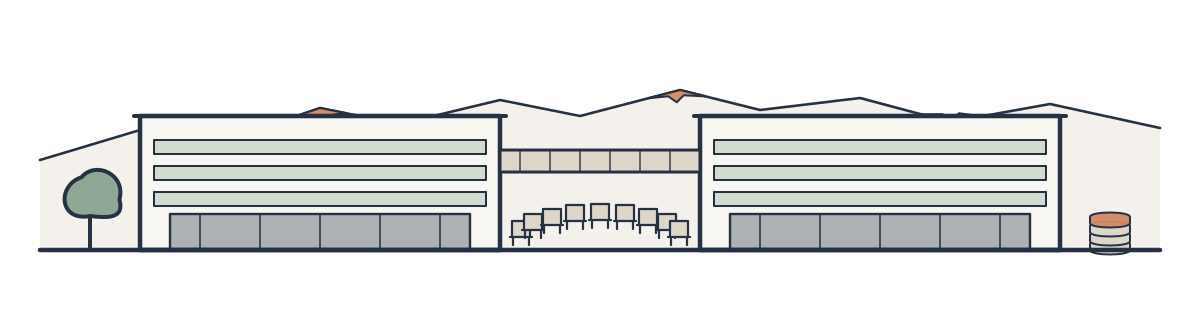
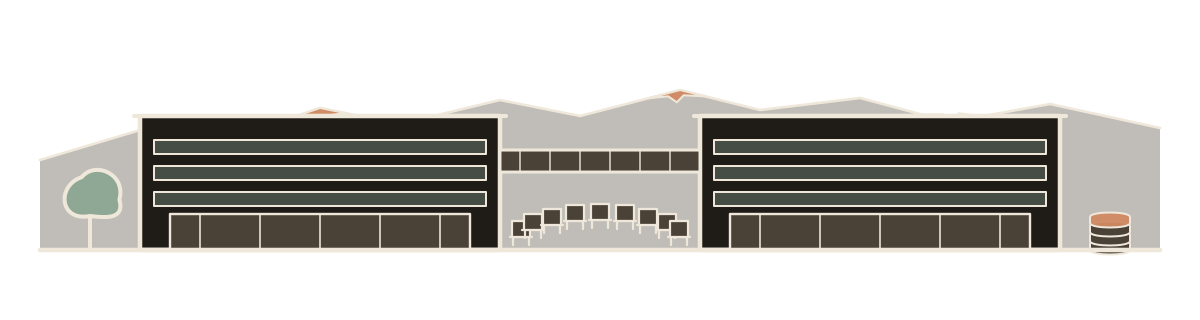
Illustration of the Salt Lake County Government Center at 2001 S. State: two flat-roofed office buildings with horizontal window bands and recessed glass ground floors, joined by a bridge, with nine empty chairs in an arc and a small stack of coins.Illustration of the Salt Lake County Government Center at 2001 S. State: two flat-roofed office buildings with horizontal window bands and recessed glass ground floors, joined by a bridge, with nine empty chairs in an arc and a small stack of coins.

Republicans hold five seats and Democrats four, and the Tribune reports control is in play. Every city ballot has the countywide At-Large A seat, open after incumbent Laurie Stringham lost at the county Republican convention.

Its winner serves six years, helping write county budgets into 2033. Most city ballots, 32 of 45 ballot styles, also have District 1.
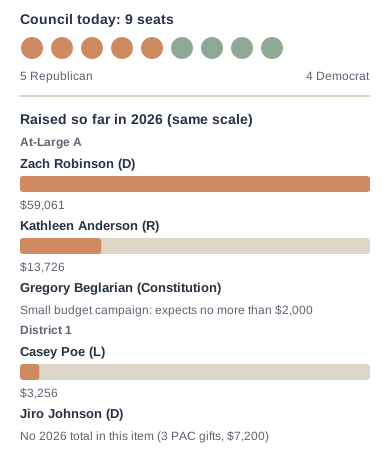
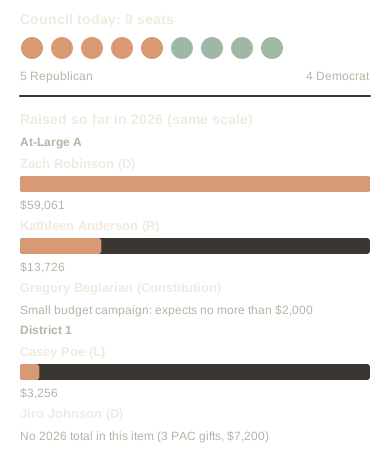
Nine dots show the County Council split, 5 Republican and 4 Democrat. Bars: Zach Robinson raised $59,061 and Kathleen Anderson $13,726 so far in 2026 for At-Large A; Casey Poe raised $3,256 in District 1.Nine dots show the County Council split, 5 Republican and 4 Democrat. Bars: Zach Robinson raised $59,061 and Kathleen Anderson $13,726 so far in 2026 for At-Large A; Casey Poe raised $3,256 in District 1.
County Council money raised so far in 2026, from county campaign finance reports. Gregory Beglarian filed as a small budget campaign, and no 2026 total is reported here for Jiro Johnson, so they have no bars. D Democrat, R Republican, L Libertarian, PAC political action committee. Chart: Salt Lake City Magazine Limited.

What this office does

The County Council is the county's lawmaking body. Its nine members pass county ordinances, adopt the yearly county budget and approve many agreements with cities and other governments.

That budget pays for county parks, libraries, the jail and the health department, and the council sets your county property tax rate. Three members are elected countywide for six-year terms; six represent districts.

At-Large A (countywide, six-year term)

What they'd do in office

  • She told the Tribune that, like families, the county should cut what it cannot afford and what no longer provides a worthwhile service. She named eliminating wasteful and duplicative spending as her top priority.

  • performance audits "at every level," readable budgets, posted votes and regular constituent hours
  • end the tax on food
  • In Big and Little Cottonwood canyons, which the county controls, she told the Tribune her rule is not to pollute streams that supply the valley, and to back conservation that does not strip vegetation that cools the air.

Donors

  • Raised: $9,911.04 this period; $13,726.36 so far in 2026
  • Top donors: Kathleen Anderson (the candidate), $6,630.29 (two gifts); Robert Anderson, $1,105.75; Paul Huntsman, $1,000
  • Source: amended interim report filed September 30, 2026, Salt Lake County Clerk

What they'd do in office

  • He told the Tribune he would also offer incentives to build affordable housing. His campaign site adds working with community organizations on cost-effective housing.

  • His other guardrails, from the Tribune questionnaire: data centers would have to mitigate infrastructure impacts, pay for their own energy and protect neighbors, with community input at the start, not after the fact.

Donors

  • Raised: $28,955 this period; $59,060.65 so far in 2026
  • Top donors: Western Regional Council of Carpenters legislative committee, $6,000; Salt Lake Board of Realtors, $2,500; Operating Engineers 3 Statewide PAC, $2,000
  • Source: interim report filed June 16, 2026, Salt Lake County Clerk

Record

He has served two terms on the Sandy City Council; county minutes from October 2022 show him speaking for Sandy on Wasatch Boulevard.

He says affordability is the issue he hears about most.

What they'd do in office

  • vote no on every tax increase
  • He told the Tribune that if residents say no, the answer is no, and that any business wanting to share profits with a town would leave that decision to the people.

Donors

  • Small budget campaign certificate filed March 30, 2026: the campaign expects to raise or spend no more than $2,000 and files one financial statement seven days before the general election.
  • Source: Salt Lake County Clerk

District 1 (most of Salt Lake City, South Salt Lake and northeast West Valley City; four-year term)

What they'd do in office

  • more treatment and alternatives to incarceration
  • He told the Tribune the county would invest in public and transitional housing to fight homelessness and partner with cities and the state on incentives for starter homes and affordable apartments near transit.

  • He told the Tribune he would give his reasoning when he votes and push for residents to get full access to the information behind every council decision.

  • He also wants protections so the technology cannot be used to surveil residents, and union labor on any construction, he told the Tribune.

Donors

  • Top donors: Salt Lake Board of Realtors, $6,000; Operating Engineers Local #3, $1,000; Miller, Grant, $200
  • Source: gifts reported by state-registered PACs and campaigns since January 1, 2025 (state filings): 3 gifts, $7,200

Record

The council's June 17, 2025 agenda lists his appointment to fill the District 1 vacancy after Arlyn Bradshaw left to become the mayor's Associate Deputy Mayor for Finance and Administration.

What they'd do in office

  • He told the Tribune the review would aim to eliminate wasteful spending and give residents clear, timely information about how their money is spent.

  • lower taxes, cut regulations that raise costs and remove barriers to building housing
  • keep the county's data center moratorium while it writes standards, with water as the top concern

Donors

  • Raised: $0 this period; $3,256.42 so far in 2026
  • Top donors: Casey Poe (the candidate), $1,900 (August 25 report)
  • Source: interim report filed September 11, 2026, Salt Lake County Clerk

Four county offices decide who is charged, who runs the jail and who counts your vote

The prosecutor, sheriff, auditor and clerk are all on your ballot. What have they done, and what do they promise?
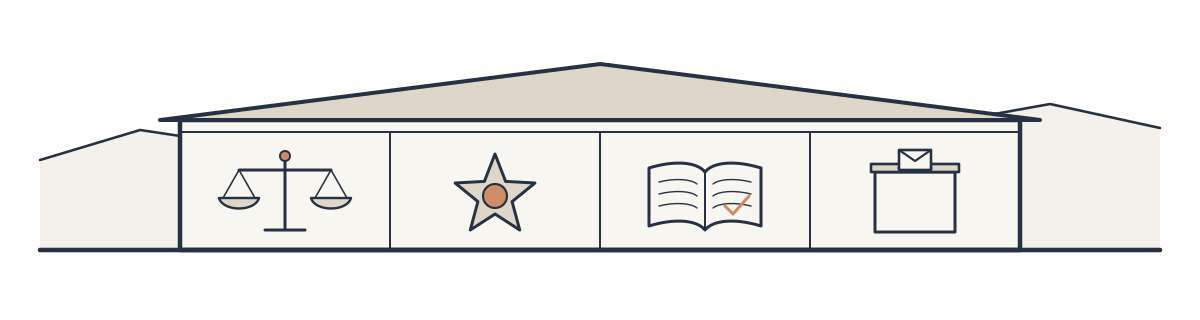

Illustration of four county offices under one roofline: a set of scales for the district attorney, a plain star badge for the sheriff, an open ledger with a check mark for the auditor, and a ballot box for the clerk.Illustration of four county offices under one roofline: a set of scales for the district attorney, a plain star badge for the sheriff, an open ledger with a check mark for the auditor, and a ballot box for the clerk.

Four countywide offices are on every Salt Lake City ballot. Between them they decide who gets charged with a crime, who runs the jail, who checks how the county spends your money and who runs your elections.

District Attorney

The District Attorney prosecutes all felony cases in Salt Lake County and handles the county's civil legal work and lawsuits. With a staff of 255, it is the largest prosecutor's office in Utah. That shapes who is charged and which diversion programs exist.

What they'd do in office

  • He told the Tribune his office prosecutes Utah law and is not a federal immigration agency, and that it will treat victims and witnesses with dignity and respect regardless of immigration status.

  • He told the Tribune that strictly enforcing environmental statutes is a good start, and that he was an early advocate of National Environmental Policy Act review for both data centers and ICE detention centers.

Donors

  • Raised: $127,356.11 this period; $411,392.11 aggregate total
  • Top gifts this period: $6,000 each from 11 givers, among them Burbidge Mitchell and Price Realty Group
  • Source: interim report filed September 15, 2026, Salt Lake County Clerk

Record

He sent the Legislature an open letter with 22 proposals on police use of force, arguing that different outcomes require different laws.

On November 7, 2023, County Council minutes show, he presented a 2024 office budget carrying a net reduction of $1,285,127 under the Mayor's recommendation.

What they'd do in office

  • His campaign site says he would put filing standards in writing so similar cases get similar treatment, document the reason for each declined case, and publish case-processing, workload and outcome numbers on a public dashboard.

  • He would set clear admission criteria, track participants and later charges, and give auditors the access they need, his site says. He told the Tribune he would change what is not working.

  • He told the Tribune this would be a change for legislators to make, so the rule does not depend on one D.A.'s practice.

  • sign the federal visa certifications that let immigrant crime victims who cooperate stay in the country

Donors

  • Raised: $20,442.27 this period; $92,491.84 so far in 2026
  • Top donors: Melissa Schultz, $6,000; Guy Woodbury, $2,000; Katie Davis, $1,184 (goods or services)
  • Source: interim report filed September 14, 2026, Salt Lake County Clerk

Record

He cites a 2025 legislative audit that found the office does not track whether program graduates reoffend.

Sheriff

The sheriff runs the county's two jails, the Metro Jail and the Oxbow Jail, and a public safety bureau that serves court papers and handles custody and protective-order matters. The office also runs search and rescue.

What they'd do in office

  • She told the Tribune she would follow the state law requiring notice to federal authorities before release, and deputies would not question community members about citizenship.

  • change state law to reduce required local involvement with ICE
  • She told the Tribune she would limit what is collected and kept, restrict access to a few trained users, limit use by other states, and that misuse should carry serious legal consequences.

Donors

  • Raised: $21,182 this period
  • Top donors: Eldin Diglisic, $3,000; Reagan Outdoor Advertising, $2,462 (goods or services); Aaron Kennard, $2,000
  • Source: interim report filed September 14, 2026, Salt Lake County Clerk

Record

She oversees about 1,100 employees and volunteers and says the office reached full staffing and ended releases forced by jail overcrowding.

In April 2025 the county asked to reopen a third housing unit at the Oxbow jail, adding 184 beds to reduce "the need for overcrowded releases."

What they'd do in office

  • He told the Tribune he would cooperate with federal law at the jail while local deputies keep the trust they need to protect every victim.

  • He told the Tribune he would also enforce stricter limits to keep private entities from capturing public data.

  • He told the Tribune nonviolent offenders who pose no safety threat belong in diversion programs, with people connected to substance abuse and mental health help once they are sober and stable again.

  • use the jail's secure medical unit for detox and stabilization before connecting people to treatment

Donors

  • Raised: $11,130.80 this period; $49,782.80 so far in 2026
  • Top donors: Michael Schultz, $6,000; DeLyle Manwaring, $1,080; Brandon Streiff, $1,000
  • Source: interim report filed September 15, 2026, Salt Lake County Clerk

Record

He told the Tribune he once took command of a 759-member military unit after serious problems with its culture and rebuilt it by putting diverse leaders in key roles and focusing on trust.

Auditor

The auditor's office reviews how the county spends money and runs the county's property tax division, so it is part of how county programs are checked and how property tax is handled.

Donors

  • Raised: $8,388.21 this period, including a $5,000 loan from Harding; $18,005.68 so far in 2026
  • Top donors: Chris Harding (the candidate), $5,000 (loan); Governing Group PAC, $2,000; Utah Association of Certified Public Accountants and Doers Network, $500 each
  • Source: interim report filed September 15, 2026, Salt Lake County Clerk

Record

County minutes from April 2024 record him telling the council that the Association of Local Government Auditors gave his office a "pass," its highest rating, in its first peer review.

His campaign notes that a 2025 state law now requires county auditors to hold at least one of five certifications.

What they'd do in office

  • Her campaign site describes the Certified Internal Auditor approach she would bring: testing internal controls, assessing risk and identifying where processes can run more efficiently, "before problems occur rather than after."

  • bring "new best practices" from years of private-sector audits to county processes

Donors

  • Raised: $8,014.92 this period; $12,454.56 so far in 2026
  • Top donors: Samantha Critelli, $1,000; Arlyn Bradshaw, $762.45 (goods or services); Alice Steiner, $500
  • Source: interim report filed September 12, 2026, Salt Lake County Clerk

Record

She holds bachelor's and master's degrees in accounting from the University of Utah and sits on the board of Clean Slate Utah, which helps people clear old records.

Clerk

The clerk runs your elections, from voter registration to managing the voting process. The same office issues marriage licenses, takes passport applications and keeps County Council minutes and agendas.

Donors

  • Raised: $2,275 this period; $24,024.32 so far in 2026
  • Top donors: Alice Steiner, $1,000; Women's Democratic Club, $600 (two gifts); Stephen Voron, $200
  • Source: interim report filed September 15, 2026, Salt Lake County Clerk

Record

County minutes record Clerk Sherrie Swensen swearing her in as clerk on January 3, 2023. Her county biography lists national awards for vote center maps, ballot reconciliation, a poll worker database and a "Try Before You Vote" program for voters with disabilities.

After a June 2024 County Auditor audit of her office's election agreements with cities, she told the council her office was writing policies in line with County policy.

Three state Senate districts split the city; here is who wants each seat

Your senator votes on income and sales tax rates. Who is asking for that vote?
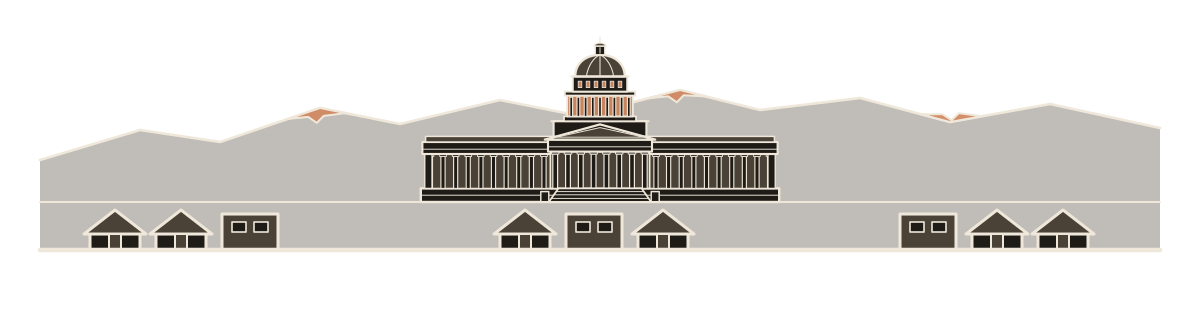
Illustration of the Utah State Capitol's south front, with its long colonnade, pediment and steps, and the drum under the dome lit, above three small clusters of homes and apartments.Illustration of the Utah State Capitol's south front, with its long colonnade, pediment and steps, and the drum under the dome lit, above three small clusters of homes and apartments.

Your state senator votes on the income and sales tax rates you pay. Salt Lake City voters fall into three Senate districts this year, according to the county's ballot style list. Here is who wants each seat.

State legislative candidates report to the state through a personal campaign committee (PCC), the account a candidate uses to raise and spend campaign money. Money figures below cover contributions reported since January 1, 2025.

What this office does

The Utah Senate has 29 senators who pass state laws and the state budget alongside the House, including state income and sales tax rates. Senators are part-time and meet in a 45-day general session each January.

Senate District 9 (22 of the city's 45 ballot styles)

What they'd do in office

What she wants to do:

  • She told the Tribune she would also remove unnecessary barriers that drive up housing costs and back responsible tax policies.

  • She told the Tribune she supports stronger conservation and investing in farm and city water efficiency, and protecting the Colorado River share through responsible use and regional cooperation.

  • protect kids' health, privacy and individual rights
  • She told the Tribune she works to earn trust by listening, being transparent about where she stands, following the evidence and making decisions in good faith.

Donors

  • Raised: $46,236, September 15, 2025 to September 24, 2026 ($1,500 of it as goods or services)
  • Top donors: Senate Dem PAC, $10,000; Alpine Auto, $5,000; WJ Plumb, $2,500

Record

She won this seat in 2022 after beating then-Sen. Derek Kitchen by 61 votes in the Democratic primary and serves as the Senate Democrats' assistant whip.

What they'd do in office

What he wants to do:

  • His campaign site says constituents would help identify priorities and give real-time input before decisions are made. He told the Tribune he would vote based on constituent feedback.

  • make it easier to build homes on land already approved, lower childcare costs, ban noncompete contracts and lower health care costs
  • meet the state's pledge to restore the Great Salt Lake by 2034; he calls the shrinking lake "an existential water crisis"
  • require transparency from AI labs and accountability when AI harms people

Donors

  • Raised: $0 in contributions reported since January 1, 2025

Record

He was nominated at the Forward Party's March 28, 2026 convention, according to Ballotpedia; this is his first campaign we found.

What they'd do in office

What he wants to do, from his answers to the Salt Lake Tribune's 2026 candidate questionnaire, published October 12:

  • He also named "good-paying jobs, responsible government spending" in the same answer.

  • He added in the same answer: "We must also work with other Colorado River states to protect Utah's long-term water security."

  • on schools: "strengthening our public schools, supporting and retaining excellent teachers, improving student outcomes, and ensuring effective use of education funding."
  • on trust in government: "I would work to make government more responsive to constituents, protect public access to information, and ensure that the voices of everyday Utahns are heard at the Capitol."

The Tribune reports he answered "Against" on Amendment A, which would move notices of proposed constitutional amendments from newspapers to a state website, and "Against" on Amendment B, which would require 60% for citizen tax initiatives.

Donors

  • Raised: $0 on each of three reports in the state disclosure portal

Senate District 13 (10 ballot styles), an open seat after Sen. Nate Blouin ran for Congress

What they'd do in office

What she wants to do:

  • She told the Tribune the state should subsidize building costs and help cities invest in the infrastructure for new or retrofitted housing. Her campaign site adds support for first-time buyers.

  • Her campaign site says she would prohibit corporations from buying up housing stock.

  • Her campaign site includes childcare subsidies for middle-class families.

  • Her campaign site backs a Great Salt Lake water trust to encourage cooperation among water users toward lake-level goals, and more funding for river and creek infrastructure that gets water to the lake.

  • modernize the power grid for reliability and a more diverse supply

Donors

  • Raised: $95,797.41, December 31, 2025 to October 11, 2026 ($998.41 of it as goods or services)
  • Top donors: ELEVATE PAC, $5,000; DAN LOFGREN, $3,500; GARRETT CATTEN, $3,289.01

Record

County minutes from July 2019 show the County Council recommending her for the Jordan Valley Water Conservancy District board, which supplies water to much of the valley.

What they'd do in office

What he wants to do:

  • housing that meets growth "while respecting single-family neighborhoods"
  • zoning that lets homeowners use water-wise landscaping without red tape
  • protection for historic properties
  • more skilled-trades training for young people who skip college
  • support for police and firefighters
  • His campaign site says that means not subsidizing city-owned properties that consistently run at a deficit, or nonessential programs that raise property taxes.

Donors

  • Raised: $1,262.37, January 20, 2026 to August 12, 2026 ($493.52 of it as goods or services)
  • Top donors: Ryan Mahoney, $419.52; Karl Jurek, $364.35; Georgia Vallejos, $260.25

Record

He is Central Region chair of the Salt Lake County Republican Party. His site says he led a petition for local businesses against a high-density construction site and did a safety audit of the 300 West bike lane.

What they'd do in office

What he wants to do:

  • He told the Tribune that means more bus and train routes and "a two-thirds cost deduction."

  • He told the Tribune the condos would be affordable and efficient, built through a public-private partnership, to help renters buy a home.

  • He told the Tribune about 68% of the water diverted in Utah goes to hay and alfalfa, and he would work with farmers on the switch.

  • protect mental health programs, parks and forests

Donors

  • Raised: $28,836.01, January 12, 2026 to October 12, 2026 ($2,398.39 of it as goods or services)
  • Top donors: Bart Bauer, $3,500; Tim Disney, $2,604.48; Forward Party of Utah, $2,467

Record

He says Forward lets him vote for the district instead of a national party line.

Senate District 14 (4 ballot styles)

What they'd do in office

What she wants to do, per her campaign site:

  • Her site says she has fought to protect Proposition 4, the initiative that creates an independent redistricting commission, and will keep working with Better Boundaries, which endorsed her.

  • Her site lists farm water efficiency programs, less corporate water waste and more money to raise lake levels. On air, she passed SB208, which cracks down on unlawful vehicle polluters, and ran SB176 to move the state to electric lawn equipment.

  • Her site lists adequate funding, competitive teacher pay, smaller classes, mental health supports and paraprofessionals. She voted against the Utah Fits All voucher program.

  • Her site says she would push for fair wages, strong unions, support for small businesses and work-family supports.

  • Her site notes she voted against HB267, which banned public sector unions from collective bargaining.

  • keep an ICE detention facility out of Utah

Donors

  • Raised: $137,792.96, January 10, 2025 to September 25, 2026 ($5,848.94 of it as goods or services)
  • Top donors: SEN DEM PAC, $10,000; BETTER BOUNDARIES ACCOUNTABILITY PAC, $6,000; Camilo Vasquez, $4,200

Record

An attorney and former deputy district attorney who led the county's Mental Health Court, she is an eight-time Utah Women's State Chess Champion and served in the Utah House from 2019 to 2023 before moving to the Senate, according to the Utah Senate Democrats.

Eight state House districts touch the city, and most ballots carry one of four

Which district is yours, and what would each candidate do in the Capitol?
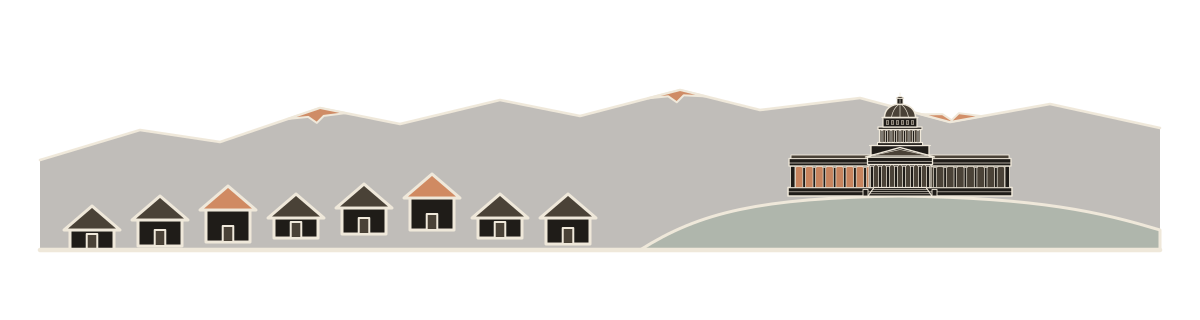
Illustration of the Utah State Capitol on its hill, its west wing colonnade lit where the House chamber sits, with eight small houses stepping across the valley floor.Illustration of the Utah State Capitol on its hill, its west wing colonnade lit where the House chamber sits, with eight small houses stepping across the valley floor.

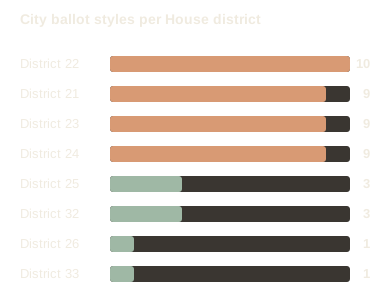
Which state House district is yours? Salt Lake City voters are spread across eight, according to the county's ballot style list, and most city ballots carry District 21, 22, 23 or 24.

A few carry 25, 26, 32 or 33. Unless noted, positions are from the Tribune's 2026 questionnaire.
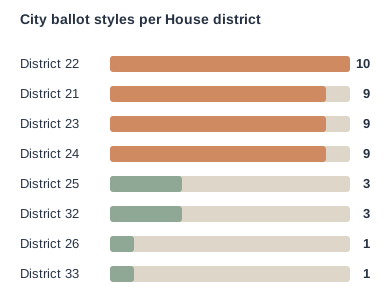
Bar chart of the city's 45 ballot styles by state House district: District 22 has 10; Districts 21, 23 and 24 have 9 each; Districts 25 and 32 have 3; Districts 26 and 33 have 1.Bar chart of the city's 45 ballot styles by state House district: District 22 has 10; Districts 21, 23 and 24 have 9 each; Districts 25 and 32 have 3; Districts 26 and 33 have 1.
A ballot style is one version of the ballot, set by which districts your address falls in. Four districts carry 37 of the city's 45 styles. Source: Salt Lake County Clerk ballot style list. Chart: Salt Lake City Magazine Limited.

Money figures cover contributions reported since January 1, 2025, from each candidate's PCC.

What this office does

The Utah House of Representatives has 75 members, each representing a different area of the state and elected to a two-year term. Representatives serve smaller districts than senators, so yours is often the state lawmaker closest to your neighborhood.

District 21 (9 ballot styles)

Donors

  • Raised: $11,968.97, January 18, 2026 to October 8, 2026 (plus $1,000 in loans)
  • Top donors: Stephen Otterstrom, $3,000; Billy Clouse, $1,500; Tenille Taggart, $1,000

District 22 (10)

What they'd do in office

What she wants to do:

  • She told the Tribune she pushed this session to free up earmarked transportation dollars for those needs.

  • She told the Tribune she would also keep pushing incentives for energy- and water-efficient buildings.

  • Cut fossil fuel subsidies whenever renewable subsidies are cut
  • Expand affordable health care

Donors

  • Raised: $64,270, January 14, 2025 to October 11, 2026
  • Top donors: Utah Mechanical Contractor Assoc, $5,000; Operating Engineers Local No 3, $4,000; John Milliken, $3,000

Record

She says she voted against expanding the Utah Supreme Court from five to seven justices.

Donors

  • Raised: $2,900, June 1, 2026 to September 15, 2026
  • Top donors: Utah House Republican Election Committee, $2,500; Aimee Winder Newton, $200; Todd Weiler, $200

District 23 (9; eastern Salt Lake City, Yalecrest and parts of Sugar House)

What they'd do in office

What she wants to do:

  • She told the Tribune she would also expand xeriscaping and water-wise landscaping policies.

  • She told the Tribune the House Democratic Caucus has made affordability its top priority for the 2027 session and will push the majority on those costs.

  • find uses for closed school buildings that earn money for schools

Donors

  • Raised: $38,562, January 16, 2025 to October 12, 2026
  • Top donors: J. Steven Price, $2,500; Tourism Works PAC, $2,250; Utah Association of Realtors, $2,000

What they'd do in office

What he wants to do:

  • improve affordability by reducing regulations and taxes and keeping markets open
  • focus on safety and cleanliness

Donors

  • Raised: $6,050, March 28, 2026 to October 6, 2026 (plus $500 in loans)
  • Top donors: Utah House Republican Election Committee, $5,000; Self, $500; Rainer F Huck, $500

Record

On water, he stresses conservation and planning for both short and long term.

What they'd do in office

What he wants to do:

  • He told the Tribune the state should mandate it, ending what he called cities "banning poor people and apartments."

  • give universal basic income a serious look

Donors

  • Raised: $83.86, March 26, 2026 to March 26, 2026
  • Top donors: Cabot Nelson, $83.86

Record

His single issue is electoral reform, including ranked-choice voting.

District 24 (9; south-central Salt Lake City)

What they'd do in office

What he wants to do:

  • renter protections, collective bargaining and prevailing wages, and a halt to corporate home buying
  • He told the Tribune he would also set up water recycling to cut reliance on the Colorado River.

Donors

  • Raised: $15,164.48, January 1, 2025 to October 5, 2026
  • Top donors: Randy Miller, $2,000; Patrick de Freitas, $1,000; Stewardship Utah, $1,000

Record

City Council minutes from January 2020 show him interviewing for a council vacancy and describing growing up in Salt Lake City.

What they'd do in office

What he wants to do:

  • cut taxes on everyday needs like food and gas
  • He told the Tribune industry would also have to recycle or reuse wastewater, and he would offer incentives for homes, businesses, farms and ranches to switch to water-smart landscaping and delivery.

  • He told the Tribune lessons would cover preparing taxes, credit scores, investing, insurance, buying a home and debt.

Donors

  • Raised: $5,025, February 9, 2026 to September 16, 2026
  • Top donors: Utah House Republican Election Committee, $2,500; Dan Reeb, $1,000; Joseph Yohanna, $500

Record

He has posted his own draft proposals on housing and health care costs on his website.

District 25 (3)

What they'd do in office

What she wants to do:

  • She told the Tribune her caucus will sponsor legislation on these this session.

  • She told the Tribune she is writing it with the House Minority Caucus.

  • In the next session, a focus on preventing sexual assault and domestic violence

Donors

  • Raised: $46,973.73, January 14, 2025 to October 15, 2026
  • Top donors: Utah Bankers Association State Pac, $6,000; The Council of State Governments, $2,408.51; Utah House Democratic Leadership Council, $1,500

What they'd do in office

He told the City Council on October 6, 2026, that in the Legislature he would work on:

  • He told the Tribune he would pass a bill for statewide xeriscaping and water recycling.

Donors

  • Raised: $2,735, December 31, 2025 to September 14, 2026
  • Top donors: Utah House Republican Election Committee, $2,500; Richard Nowak, $200; John Vollbrecht, $30

Record

His Tribune answers call for a statewide xeriscaping and water recycling bill and less screen time for students.

District 26 (1)

What they'd do in office

What he wants to do:

  • put Utah in the top three states for education

Donors

  • Raised: $148,158.34, June 6, 2025 to October 15, 2026 ($3,750 of it as goods or services; plus $20,000 in loans)
  • Top donors: Utah House Republicans Election Committee PAC, $50,000; House Speaker Leadership PAC, $35,000; Matt S MacPherson, $20,000

Record

  • a sixth straight income tax cut
  • a 15% gas tax cut
  • an expanded child tax credit
  • nearly $100 million toward the Great Salt Lake
  • more than $145 million in new public school money, with starting teacher pay near $60,000

What they'd do in office

What he wants to do:

  • build more affordable housing and limit corporate investors buying homes
  • end the state tax on Social Security
  • protect vote by mail
  • have developers pay for the infrastructure their projects need
  • He told the Tribune this means undoing HB 267, which took collective bargaining away from firefighters, teachers and police officers.

Donors

  • Raised: $103,198.21, January 7, 2026 to October 14, 2026 ($1,500 of it as goods or services)
  • Top donors: Elevate PAC, $25,000; UIN PAC, $11,000; Utah House Democratic Leadership Council, $10,000

District 32 (3)

What they'd do in office

What she wants to do:

  • back her caucus's affordability bills on childcare and workers' rights
  • She told the Tribune she is supporting a House Democrats bill to increase transparency about data center water use.

  • support public schools and teachers

Donors

  • Raised: $9,455, July 7, 2025 to October 14, 2026
  • Top donors: Committee to Elect Jennifer Dailey-Provost, $2,000; Utah House Democratic Leadership Council, $1,500; UINPAC, $1,500

What they'd do in office

What she wants to do:

  • She told the Tribune that regulating rent increases and add-on fees, and zoning for small units, can help.

  • She told the Tribune she would also discourage high-demand crops grown mainly for export, and look at moisture harvesting, phragmites control and monitoring lakebed dust.

  • She told the Tribune that means helping them integrate and contribute.

Donors

  • Raised: $1,528.36, January 13, 2026 to September 23, 2026 ($42.50 of it as goods or services; plus $1,000 in loans)
  • Top donors: Aileen Hampton, $1,083.86; Fred Bytendorp, $200; Diane Moffat, $100

District 33 (1)

What they'd do in office

What he wants to do:

  • He told the Tribune he would also preserve existing affordable homes and scrutinize tax incentives that shift costs onto families.

  • He told the Tribune he would also optimize farm water use and require water-intensive developments to account for their impact.

  • He told the Tribune he will keep pressing for transparent water and energy use, fair allocation of infrastructure costs, and safeguards so communities and ratepayers do not carry the burden of private development.

Donors

  • Raised: $79,282.89, January 16, 2025 to October 14, 2026 ($3,550 of it as goods or services)
  • Top donors: David Cumming, $10,000; Bronze Rhinos LLC, $7,000; Angela Dumke, $5,500

What they'd do in office

What she wants to do:

  • routine scrutiny of taxes, fees and spending
  • strong conflict-of-interest rules
  • research into new water sources such as recycling, atmospheric capture and desalination
  • She told the Tribune informed consent should be meaningful, not buried in pages of legal language.

She opposes Amendments A and B.

Donors

  • Raised: $5,478.99, March 26, 2026 to October 10, 2026 (plus $79.70 in loans)
  • Top donors: Utah House Republican Election Committee, $5,000; Anna Reeves, $478.99

The school board voted to cut $5 million this year, and four city seats are on the ballot

The next board inherits those cuts. Who is running to make them?
Illustration of a schoolhouse with a bell cupola, four student desks in a row, and a budget pie chart with one slice lifted out.Illustration of a schoolhouse with a bell cupola, four student desks in a row, and a budget pie chart with one slice lifted out.

In June the Salt Lake City School Board voted to cut $5 million over the year, and the next board inherits those cuts. Four city seats are on the ballot.

On June 2, 2026, after two budget motions failed, the board unanimously adopted the 2026-27 budget with direction to cut $5 million over the year and add no new district office positions until the district is out of non-bond debt.

The same motion requires a budget update at every business meeting and a revised district office staffing plan by January 2027. Whoever wins will be the ones holding the district to that plan. Four precincts vote this year.

What this office does

The Salt Lake City Board of Education governs the city's public schools. Members are elected by precinct to four-year terms. The board adopts the district budget and votes on school closures, so it shapes which school your child attends and how money reaches classrooms.

Precinct 3

What they'd do in office

A feasibility study is a report that checks whether a specific plan, here reusing or selling particular buildings, can actually work and what it would cost.

Donors

  • Top donors: Reale, Sarah, $500; Planned Parenthood Action Council, $500; Dailey-Provost, Jen, $250
  • Source: Gifts from state-registered PACs and campaigns since January 1, 2025: 4 gifts, $1,350

Record

If your neighborhood lost an elementary school, her votes are worth a look.

In January 2024 the board voted to close Hawthorne, M. Lynn Bennion, Mary W. Jackson and Riley elementaries. In September 2025, deciding what to do with those empty buildings, the board voted 5 to 2 to order a feasibility study.

Anderson wanted a wider look first: a study of what the whole district needs and what shape all its buildings are in.

She was one of the two no votes, and in April 2026, minutes show, she raised a formal objection when her request to put that needs study on the agenda had not been added.

Record

District minutes show him presenting the West High School clinic to the board in November 2022.

Precinct 4: the seat with no printed name

Record

Board president Nate Salazar, re-elected president 5 to 2 in January 2025, is not running, and no one filed to have their name printed.

One person has registered as a write-in candidate, according to the county clerk's certification notice: Amanda Finlayson. Her campaign site describes her as a 15-year resident, a school social worker and a parent at Bryant Middle School.

Because write-in votes only count for registered write-in candidates, a few hundred neighbors writing a name could decide this seat.

To vote for a write-in candidate, write the name on the write-in line and mark the box next to it, following the instructions printed on your ballot.

Precinct 5 (two years left on the term)

Record

A first motion to appoint Elisabeth Bunker failed; the board then voted 5 to 1 to appoint Ann Elizabeth (Annie) Romano, who was sworn in that night by County Clerk Lannie Chapman. Romano has a nonprofit management background, according to the district.

Precinct 6

Record

In October 2025 he and Romano voted against removing language about preferential applications from Policy B-1, the board's "Legal Status, Responsibilities and Ethics" policy; the change passed 4 to 2, according to the October 21, 2025 minutes.

Also on some city ballots, all unopposed

Donors

  • Raised: $20,781.42, November 4, 2025 to September 10, 2026 ($12,490.42 of it as goods or services)
  • Top donors: Governing Group PAC, $12,490.42; Beverly and Raymond Ward, $1,500; Davis County Republican Party, $1,000

Donors

  • Raised: $8,108.45, April 21, 2025 to September 25, 2026 ($188.45 of it as goods or services)
  • Top donors: Carol Lear, $800; Ruby Mountain Inc, $500; Anne Cazier, $500

The county parks bond would build an all-abilities playground downtown and replace Tanner Park's playground and pavilion

What would the parks bond build near you, and what would it cost?
Illustration of Tanner Park, where the parks bond would replace the playground and pavilion: a simple play tower with a slide, a swing set and a hip-roofed pavilion over a picnic table, between tall trees with the creek in front.Illustration of Tanner Park, where the parks bond would replace the playground and pavilion: a simple play tower with a slide, a swing set and a hip-roofed pavilion over a picnic table, between tall trees with the creek in front.

Picture a new playground at Library Square, built so kids of every ability can play side by side. It is one of four Salt Lake City projects on the county parks bond.

The others: a new playground and pavilion at Tanner Park, a bigger Northwest Recreation Center with a gym and space for seniors, and repairs at Fairmont Aquatic Center. If you have pushed a stroller around Tanner Park or swum at Fairmont, this is your neighborhood.
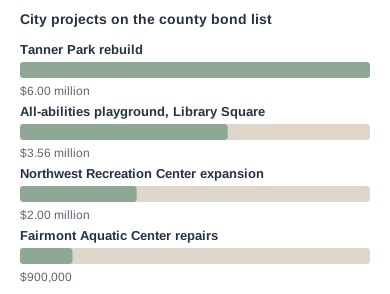
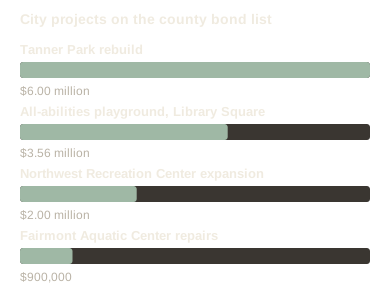
Bar chart of county parks bond projects in the city: Tanner Park rebuild $6 million, Library Square all-abilities playground $3.56 million, Northwest Recreation Center $2 million, Fairmont Aquatic Center repairs $900,000.Bar chart of county parks bond projects in the city: Tanner Park rebuild $6 million, Library Square all-abilities playground $3.56 million, Northwest Recreation Center $2 million, Fairmont Aquatic Center repairs $900,000.
Salt Lake City projects on the county's $128 million parks bond list. A general obligation bond is a loan the county repays from property taxes. Source: Salt Lake County proposed bond projects. Chart: Salt Lake City Magazine Limited.

Countywide, the bond would pay for parks, trails, open space and recreation centers, with the biggest new centers in West Jordan and Midvale. The ballot asks whether the county may borrow up to $128 million to do it.

What it costs you: the ballot puts the new debt at about $1.37 a month for an average-value home. The county expects those payments to replace parks bonds from 2016 that are being paid off, so it estimates no change to today's bill.

What it costs, and how it compares

A general obligation bond is a loan the county repays, with interest, from property taxes. The county plans to borrow in two parts over about five years.

The ballot puts the new debt at $16.39 a year for a home at the county average value of $658,000, or about $1.37 a month. A business property of the same value would pay $29.80 a year, about $2.48 a month.

Running the new places is a separate cost: about $4.7 million a year countywide. The county says it will decide in its next budget whether that means cuts elsewhere or a tax increase.

Project costs in Salt Lake City: Library Square playground, $3.56 million; Tanner Park, $6 million; Northwest Recreation Center, $2 million; Fairmont Aquatic Center, $900,000. The West Jordan and Midvale centers are $25.8 million and $21 million.

According to the Tribune, county voters have approved similar bonds about every 10 years since 1996, though not every county bond passes: county minutes record that the $507 million jail bond on the November 2024 ballot failed.

Two parks bonds, one city

This is not the City's bond. In November 2022, Salt Lake City voters said yes to their own $85 million Parks, Trails and Open Space bond, with 71.32% of the vote.

That money is already in the ground: it paid $750,000 toward the makeover of Donner Trail Park, which reopened this month with a new memorial grove.

On February 17, 2026, the City Council adopted a resolution authorizing a second round of borrowing, up to $51 million in general obligation bonds, from that same voter approval.

City residents pay for both the city and county bonds, and this county vote would not change the city one.

Full text of the county bond proposition

Shall Salt Lake County, Utah, be authorized to issue general obligation bonds in an amount not to exceed $128,000,000 and to mature in no more than eleven (11) years from the date or dates of issuance of such bonds for the purpose of providing funds for repairing, completing, acquiring, constructing or renovating open space, natural habitat, parks, community trails and recreational facilities and other related facilities under the charge of the County and, to the extent necessary, for providing moneys for the refunding, at or prior to the maturity thereof, of general obligation bonds of the County authorized hereunder or heretofore issued and now outstanding?
PROPERTY TAX COST OF BONDS
A general obligation bond is a debt owed by the County. The County uses tax revenue to pay for the debt. If the bonds are issued as planned (which currently consists of 2 smaller issues of bonds totaling approximately $128,000,000 over the next 5 years, with each issue of bonds maturing approximately 10 years from the date it is issued), without regard to the taxes currently levied to pay outstanding bonds that will decrease over time, an annual property tax to pay debt service on the proposed bonds will be required over a period of 10 years in the estimated amount of $16.39 per year on a primary residence with the County average value of $658,000 and in the estimated amount of $29.80 per year on a business or secondary residence having the same value, which are equal to a monthly increase of $1.37 for an average residential property and $2.48 on a business property having the same value.
The County currently levies property taxes to pay debt service on other outstanding general obligation bonds that have been issued to finance voter approved projects. The incremental property taxes would decrease upon the repayment of the currently outstanding bonds, but the decrease may not occur if the proposed bonds are issued. Taking into account the repayment of the outstanding bonds, the County expects that the issuance of the proposed bonds, in the manner currently expected, will result in a net property tax increase of $0 per year on a primary residence with the County average value of $658,000 and a net property tax increase of $0 per year on a business or secondary residence having the same value, which are equal to a monthly increase of $0 for an average residential property and $0 on a business property having the same value.
The foregoing is only an estimate and is not a limit on the amount of taxes that the governing body may be required to levy in order to pay debt service on the bonds. The governing body is obligated to levy taxes to the extent provided by law in order to pay the bonds.
In addition to the bond payment costs as outlined above, based on current best estimates, the average annual combined net operational and maintenance costs for these facilities during their first ten years of operation is projected to require additional annual expenditures of $4,710,200. If approved, the county will determine during its next budget cycle whether additional operational and maintenance costs may or may not require any additional funds from budget cuts or a tax increase.
To vote in favor of the above bond issue, select the box immediately adjacent to the words “FOR THE ISSUANCE OF BONDS.” To vote against the bond issue, select the box immediately adjacent to the words “AGAINST THE ISSUANCE OF BONDS.”

Ballot text: $16.39 a year divided by 12 is about $1.37 a month on a primary residence at the county average value of $658,000; $29.80 divided by 12 is about $2.48 a month on a business property. The ballot itself states both monthly figures and a net change of $0 after retiring bonds are paid off.

Amendment A would move proposed amendments from newspapers to a state website

Where should the state publish changes to the Constitution before you vote on them?

Illustration of Amendment A: a short stack of blank newspapers and a dotted arrow to a laptop showing a notice bell.Illustration of Amendment A: a short stack of blank newspapers and a dotted arrow to a laptop showing a notice bell.

Amendment A asks where the state should publish proposed changes to the Utah Constitution before you vote on them. Today the Constitution requires lawmakers to print every proposed amendment in a newspaper in every county for two months.

Amendment A would replace that with 60 days of publication "in a manner established by state law." A companion law, H.B. 481, would have the lieutenant governor post each proposal on the Utah Public Notice Website and the lieutenant governor's website.
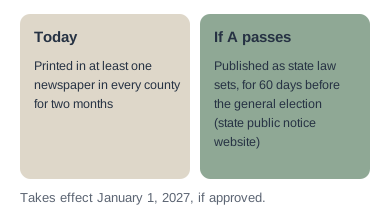
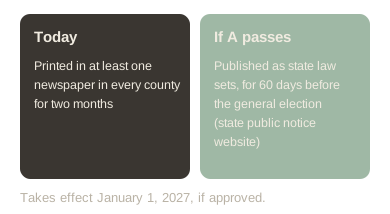
Two panels. Today: proposed amendments are printed in a newspaper in every county for two months. If Amendment A passes: published as state law sets for 60 days before the election, which a companion law puts on the state public notice website.Two panels. Today: proposed amendments are printed in a newspaper in every county for two months. If Amendment A passes: published as state law sets for 60 days before the election, which a companion law puts on the state public notice website.
What Amendment A changes, from the 2026 Utah Voter Information Pamphlet. The companion law, H.B. 481 (a House bill passed by the Legislature), sets the website. Chart: Salt Lake City Magazine Limited.

Why it's on the ballot: in 2024 the Utah Supreme Court voided an amendment in part because the newspaper step was missed, according to the state Voter Information Pamphlet.

Supporters, Rep. Anthony Loubet and Sen. Daniel McCay, say most Utahns now get information online. The pamphlet's fiscal note estimates savings of up to $1.4 million every two years. If voters approve, the change takes effect January 1, 2027.

Full text of Amendment A

Utah Constitution, Article XXIII, Section 1, as it would read if Amendment A passes:
"Any amendment or amendments to this Constitution may be proposed in either house of the Legislature, and if two-thirds of all the members elected to each of the two houses, shall vote in favor thereof, such proposed amendment or amendments shall be entered on their respective journals with the yeas and nays taken thereon; and the Legislature shall cause the same to be published, in a manner provided by statute, for 60 calendar days immediately preceding the next general election, at which time the said amendment or amendments shall be submitted to the electors of the state for their approval or rejection, and if a majority of the electors voting thereon shall approve the same, such amendment or amendments shall become part of this Constitution.
The revision or amendment of an entire article or the addition of a new article to this Constitution may be proposed as a single amendment and may be submitted to the electors as a single question or proposition.
Such amendment may relate to one subject, or any number of subjects, and may modify, or repeal provisions contained in other articles of the Constitution, if such provisions are germane to the subject matter of the article being revised, amended or being proposed as a new article."
Section 3 of the resolution (H.J.R. 10, 2025): "If the amendment proposed by this joint resolution is approved by a majority of those voting on it at the next regular general election, the amendment shall take effect on January 1, 2027."

Amendment B would make citizen tax initiatives pass with 60%, not a simple majority

Who decides how hard it is for voters to raise a tax themselves?

Illustration of Amendment B: one ballot box with an envelope in its slot and a drawn dollar sign on the front, beside a tall bar filled to the halfway mark with a terracotta rise up to a higher 60 percent line and an up arrow.Illustration of Amendment B: one ballot box with an envelope in its slot and a drawn dollar sign on the front, beside a tall bar filled to the halfway mark with a terracotta rise up to a higher 60 percent line and an up arrow.

In Utah, voters can write a law themselves, gather signatures and put it on the statewide ballot. Today it passes with a simple majority, more than half the votes. Amendment B would raise that bar to 60% for any citizen initiative that raises taxes.

According to the state's impartial analysis, that means any initiative that creates a new tax, applies a tax to more things, raises a tax rate, or shrinks a property tax cut that would otherwise happen.

Other initiatives would still need only a majority, and the Legislature itself could still raise taxes with a simple majority.

Who put it on the ballot: lawmakers did. The Utah Senate voted 21 to 8 and the House 55 to 17 to send Amendment B to voters. The legislative fiscal analyst says it would not materially change state revenue.

Supporters, in the pamphlet's argument for, signed by sponsors Sen. Lincoln Fillmore and Rep. Jason Kyle, say taxes touch every family budget and should pass only with broad agreement.

They add that it matters especially because an initiative is written by its backers alone and is hard to fix once passed.

Opponents, in the argument against, signed by Sen. Luz Escamilla and Rep. Angela Romero, call it a "power grab" that holds voters to a stricter standard than lawmakers and say it could lead to higher bars for other initiatives.

The Tribune reports that Better Boundaries is campaigning against it.

Who is Better Boundaries? A Salt Lake City group formed in 2017 to put an independent redistricting commission on the ballot. Voters approved that plan, Proposition 4, in 2018.

The group now works, in its own words, against gerrymandering and to protect citizen initiatives, and it raised money for the lawsuit that led to this year's court-ordered congressional map. Elizabeth Rasmussen is executive director, according to the group's website.

Full text of Amendment B

Amendment B (S.J.R. 2, 2025) would amend Utah Constitution, Article VI, Section 1 to read:
"(1) The Legislative power of the State shall be vested in:
(a) a Senate and House of Representatives which shall be designated the Legislature of the State of Utah; and
(b) the people of the State of Utah as provided in Subsection (2).
(2)(a)(i) The legal voters of the State of Utah, in the numbers, under the conditions, in the manner, and within the time provided by statute, may:
(A) initiate any desired legislation and cause it to be submitted to the people for adoption upon a majority vote of those voting on the legislation, as provided by statute; or
(B) require any law passed by the Legislature, except those laws passed by a two-thirds vote of the members elected to each house of the Legislature, to be submitted to the voters of the State, as provided by statute, before the law may take effect.
(ii) Notwithstanding Subsection (2)(a)(i)(A), legislation initiated to allow, limit, or prohibit the taking of wildlife or the season for or method of taking wildlife shall be adopted upon approval of two-thirds of those voting.
(iii) Notwithstanding Subsection (2)(a)(i)(A), initiated legislation that is subject to a vote that occurs after November 1, 2026, shall be adopted upon approval of at least 60% of those voting on the legislation if the initiated legislation includes:
(A) the imposition of a new tax;
(B) an expansion of an existing tax to include additional items or transactions subject to the tax;
(C) an increase in an existing tax rate; or
(D) for a property tax, a change to the tax rate that causes the tax rate to decrease less than it would under current law.
(b) The legal voters of any county, city, or town, in the numbers, under the conditions, in the manner, and within the time provided by statute, may:
(i) initiate any desired legislation and cause it to be submitted to the people of the county, city, or town for adoption upon a majority vote of those voting on the legislation, as provided by statute; or
(ii) require any law or ordinance passed by the law making body of the county, city, or town to be submitted to the voters thereof, as provided by statute, before the law or ordinance may take effect."
Section 3 of the resolution: "If the amendment proposed by this joint resolution is approved by a majority of those voting on it at the next regular general election, the amendment shall take effect on November 23, 2026."

All 16 judges on city ballots met the state's performance standards

How does the state grade a judge, and what did lawyers and observers say?
Illustration of the Scott M. Matheson Courthouse at 450 S. State: two symmetrical stone wings with a rusticated base and a taller rounded glass center topped by a dome, with a scales mark on the right and a clipboard of check marks on the left.Illustration of the Scott M. Matheson Courthouse at 450 S. State: two symmetrical stone wings with a rusticated base and a taller rounded glass center topped by a dome, with a scales mark on the right and a clipboard of check marks on the left.

Near the bottom of your ballot is a run of yes or no questions that are easy to skip: should this judge stay on the bench? Utah judges are appointed first and face voters later.

Before each retention vote, the Utah Judicial Performance Evaluation Commission surveys the lawyers and court staff who appear before each judge, sends trained observers into courtrooms and publishes what it finds. Every judge below meets or exceeds the commission's standards.
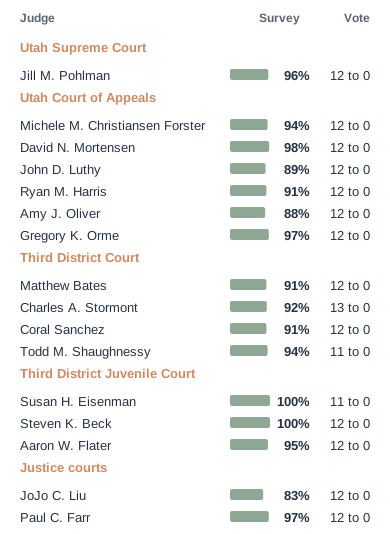
Table of all 16 judges on city ballots. Survey shares recommending retention run from 83% to 100%, and every commission vote was unanimous.Table of all 16 judges on city ballots. Survey shares recommending retention run from 83% to 100%, and every commission vote was unanimous.
Survey: share of lawyers and court staff who answered and recommend keeping the judge. Vote: the Utah Judicial Performance Evaluation Commission (JPEC, the state panel that grades judges) vote that the judge meets standards. Chart: Salt Lake City Magazine Limited.

Utah Supreme Court

Commission recommendation: Meets or exceeds performance standards (commission vote 12 to 0).

Survey: 96% of lawyers and court staff who answered recommend retention.

Background: Appointed to the Supreme Court in 2022 by Gov. Spencer Cox from the Court of Appeals, where she was associate presiding judge. Before the bench she spent 19 years as a complex civil litigation partner at Stoel Rives.

The Utah Senate confirmed her on August 17, 2022, by 25 to 0.

What respondents said: "intellectually curious"; one said she "exemplifies the mission of the judiciary."

Full evaluation

Hideout v. Summit County (Utah Supreme Court, 2024). Read the opinion

The town of Hideout annexed land in Summit County during a roughly 100-day window in 2020 when state law allowed it without county consent. Writing for the court, Pohlman held the county lacked standing to challenge the annexation, reversing a ruling in its favor.

Bingham v. Gourley (Utah Supreme Court, 2024). Read the opinion

A patient challenged the four-year limit in Utah's health care malpractice law, which can bar a suit before a patient learns of an injury. Pohlman's opinion held the patient had not shown a constitutional violation and upheld the dismissal.

State v. Andrus (Utah Supreme Court, 2025). Read the opinion

The court upheld a man's convictions for a sexual relationship with a 16-year-old. Pohlman agreed on all but one issue: she would have suppressed phone subscriber records that a state detective got through federal officers without following Utah's digital privacy law.

Utah Court of Appeals

Commission recommendation: Meets or exceeds performance standards (commission vote 12 to 0).

Survey: 94% of lawyers and court staff who answered recommend retention.

Background: On the court since 2010, after three years as a Third District judge. Earlier a federal prosecutor, executive director of the Utah Commission on Criminal and Juvenile Justice and general counsel to Gov. Jon Huntsman Jr.

What respondents said: well prepared and thoughtful in oral arguments; kind and approachable.

Full evaluation

In re P.M. (Utah Court of Appeals, 2025). Read the opinion

She wrote the opinion upholding a Third District Juvenile Court ruling that a baby was dependent as to the mother, rejecting the mother's due process arguments. The same day, the court reversed the ruling as to the father.

State v. Beames (Utah Court of Appeals, 2022). Read the opinion

The majority reversed a woman's drug convictions, holding her lawyer should have moved to suppress drugs found after a police dog jumped into her car. Christiansen Forster dissented, writing that the woman had not shown such a motion would have succeeded.

State v. Nunes (Utah Court of Appeals, 2020). Read the opinion

She wrote the 2 to 1 opinion upholding a rape conviction and rejecting claims that the trial lawyer was ineffective. Judge Gregory Orme dissented.

Commission recommendation: Meets or exceeds performance standards (commission vote 12 to 0).

Survey: 98% of lawyers and court staff who answered recommend retention.

Background: On the court since 2016, after almost 10 years as a Fourth District trial judge in Utah County, where he was presiding judge. Earlier a private trial attorney; two terms on the Judicial Conduct Commission.

What respondents said: praise for his preparation and timely opinions.

Full evaluation

Al-Imari v. UDOT (Utah Court of Appeals, 2026). Read the opinion

A family's car-crash suit against UDOT and a contractor was thrown out after their expert was barred over a deficient disclosure. The court split. Mortensen dissented, writing that under the civil rules the expected result of a failed disclosure is exclusion of the evidence.

Northern Monticello Alliance v. San Juan County (Utah Court of Appeals, 2023). Read the opinion

In a long-running dispute over a conditional use permit in San Juan County, he wrote the opinion reversing a lower court ruling, holding that only the county Planning Commission was authorized to weigh the evidence.

State v. Scott (Utah Court of Appeals, 2022). Read the opinion

As a Fourth District trial judge, Mortensen gave a deadlocked murder jury an instruction urging a verdict. The Court of Appeals, with Mortensen not sitting on the case, held the instruction was not coercive and upheld the conviction.

Commission recommendation: Meets or exceeds performance standards (commission vote 12 to 0).

Survey: 89% of lawyers and court staff who answered recommend retention.

Background: Appointed in 2022. Cache County's chief civil deputy and then county attorney; practiced in Salt Lake City and Logan; taught legal writing at the University of South Carolina School of Law; early in his career clerked for Judge Gregory Orme, also on this ballot.

What respondents said: kindness and thorough questioning.

Full evaluation

State v. Bridgewaters (Utah Court of Appeals, 2025). Read the opinion

He wrote the opinion reversing a conviction because the trial court denied the defendant's explicit request to represent himself without finding that the request was not knowing and intelligent.

State v. Wahlstrom (Utah Court of Appeals, 2026). Read the opinion

A man was found intoxicated in the driver's seat of a parked truck in the mountains. Luthy's opinion held that an instruction pushing the deadlocked jury toward a verdict was coercive, and reversed the DUI conviction while leaving his other convictions in place.

State v. Vargas (Utah Court of Appeals, 2025). Read the opinion

He wrote the opinion upholding a Third District conviction, rejecting the defendant's claims that his trial lawyer was ineffective.

Commission recommendation: Meets or exceeds performance standards (commission vote 12 to 0).

Survey: 91% of lawyers and court staff who answered recommend retention.

Background: Joined the court in 2017 after nearly six years as a Third District judge and eight years as a small claims judge. Twice received the Utah State Bar Litigation Section's Judicial Excellence Award.

What respondents said: his timely opinions are valued, while a few say his demeanor shows irritation with arguments he disagrees with.

Full evaluation

Farm Bureau v. Weston (Utah Court of Appeals, 2023). Read the opinion, Later ruling

The court held an insurer breached its duty to defend a driver in a fatal-crash suit. Harris agreed on that but dissented in part, writing that an insurer that breaches that duty can still raise coverage defenses later.

Walmart v. Tax Commission (Utah Court of Appeals, 2025). Read the opinion

Walmart challenged Salt Lake County's 2016 property tax values for three of its large retail properties, in a case tried in Second District Court in Farmington. Harris wrote the opinion upholding the district court's valuation.

Ramirez v. Hon. Landau (Utah Court of Appeals, 2026). Read the opinion

A defendant asked the court to vacate a Salt Lake City Justice Court order in his DUI case. Harris's opinion dismissed the petition as moot because the defendant later pleaded to a misdemeanor DUI in district court.

Commission recommendation: Meets or exceeds performance standards (commission vote 12 to 0).

Survey: 88% of lawyers and court staff who answered recommend retention.

Background: Appointed in January 2023 from the Third District bench. Earlier a federal prosecutor and assistant director of the Securities and Exchange Commission's Salt Lake Regional Office.

What respondents said: work ethic and courtesy.

Full evaluation

State v. Mitton (Utah Court of Appeals, 2024). Read the opinion, Later ruling

After a trial judge disclosed he was distantly related by marriage to a witness's family, a mistrial was declared. Oliver's opinion held that double jeopardy barred a retrial. In 2026 the Utah Supreme Court reversed and reinstated the case.

Griffin v. Snow Christensen and Martineau (Utah Court of Appeals, 2023). Read the opinion, Later ruling

The majority held a malpractice suit was properly served by handing papers to a law firm's office administrator. Oliver dissented, writing that service was ineffective. In 2025 the Utah Supreme Court agreed with her reading.

Gallegos v. Brewski's (Utah Court of Appeals, 2026, a Second District case from Ogden). Read the opinion

A man sued Brewski's on Historic 25th Street after an employee forcibly removed him. Oliver's opinion revived his negligent hiring, training and supervision claim against the bar, while upholding the trial court's sanctions rulings.

Commission recommendation: Meets or exceeds performance standards (commission vote 12 to 0).

Survey: 97% of lawyers and court staff who answered recommend retention.

Background: The longest-serving member of the Court of Appeals and twice its presiding judge; the Utah State Bar named him Judge of the Year in 2007.

What respondents said: "exceptionally capable."

Full evaluation

State v. Nunes (Utah Court of Appeals, 2020). Read the opinion

The majority upheld a rape conviction. Orme dissented, writing that the trial lawyer was deficient for withdrawing a hearsay objection and not objecting to bolstering testimony, and that the defendant deserved a new trial.

State v. Sorbonne (Utah Court of Appeals, 2020). Read the opinion

A 19-year-old who pointed a gun at his father claimed self-defense. The majority upheld his conviction. Orme dissented, writing that he had a "definite and firm belief" the conviction resulted from multiple errors.

State v. Miller (Utah Court of Appeals, 2019). Read the opinion

The majority held that a Summit County traffic stop on Interstate 80 was not unconstitutionally prolonged before officers found marijuana.

Orme dissented: "I agree with Miller that the officer prolonged the stop by requesting a 'Triple I check' as a means to buy himself additional time to conduct the dog sniff."

Third District Court (Salt Lake, Summit and Tooele counties)

Commission recommendation: Meets or exceeds performance standards (commission vote 12 to 0).

Survey: 91% of lawyers and court staff who answered recommend retention.

Background: Appointed in 2016 by Gov. Gary Herbert. Earlier chief prosecutor in the Summit County Attorney's Office, and worked in the Salt Lake County District Attorney's Office and the Attorney General's litigation and criminal appeals divisions.

What respondents said: informative and respectful; observers noted his consideration of defendants' circumstances.

Full evaluation

Anderson v. Hon. Bates and McCaffrey v. Anderson (Utah Supreme Court, 2025 and 2026). Read the opinion, Later ruling

Bates ruled that the state's town-incorporation law, as applied to landowners added late to a proposed Summit County town, West Hills, violated the Utah Constitution, stopping the 2025 vote. In 2026 the Utah Supreme Court reversed, holding the law constitutional.

State v. Menzies (Utah Supreme Court, 2025). Read the opinion, Later ruling

Bates found death-row inmate Ralph Leroy Menzies, who has vascular dementia, competent to be executed. The Utah Supreme Court held he erred by weighing the State's rebuttal evidence at the threshold stage, reversed, and vacated the execution warrant.

Peng v. Meeks (Utah Supreme Court, 2024). Read the opinion

In a malpractice trial over a mother's death after her children withdrew life support, the Utah Supreme Court upheld Bates's jury instruction but held he should have granted judgment for the doctors on one claim.

Commission recommendation: Meets or exceeds performance standards (commission vote 13 to 0).

Survey: 92% of lawyers and court staff who answered recommend retention.

Background: Appointed in June 2023. Immediately before, he was UDOT's director of right of way; earlier a civil litigator focused on eminent domain and business cases.

What respondents said: fair and patient; several say he should manage his court calendar more efficiently.

Full evaluation

Commission recommendation: Meets or exceeds performance standards (commission vote 12 to 0).

Survey: 91% of lawyers and court staff who answered recommend retention.

Background: Appointed in December 2022. Led the Davis County Attorney's special victims unit and earlier the special victims and juvenile units at the Salt Lake County District Attorney's Office; State Prosecutor of the Year in 2019 (Utah Crime Victims Council).

What respondents said: a clear communicator who makes sure people understand.

Full evaluation

State v. Jennings (Utah Supreme Court, 2026). Read the opinion

Sanchez denied a murder defendant's request to dismiss under Utah's pretrial self-defense hearing law. The Utah Supreme Court affirmed and held that defendants must present evidence at that hearing.

Armenta v. Unified Fire (Utah Supreme Court, 2025). Read the opinion

Sanchez dismissed a man's suit claiming Unified Fire Authority EMTs missed signs of his heart attack, holding the agency was immune. The Utah Supreme Court reversed.

State v. Connelley (Utah Court of Appeals, 2026). Read the opinion

The Court of Appeals vacated three credit-card convictions that should have merged with aggravated robbery, which the State conceded, but upheld Sanchez's consecutive sentences for sexual assault and other violent crimes.

Commission recommendation: Meets or exceeds performance standards (commission vote 11 to 0).

Survey: 94% of lawyers and court staff who answered recommend retention.

Background: Appointed in 2011 after practicing as a partner at Snell & Wilmer; sits on the Utah Judicial Council.

What respondents said: experienced and careful.

Full evaluation

State v. Clara (Utah Supreme Court, 2024). Read the opinion

A driver fired seven shots toward a snowplow truck that had rammed his SUV in Salt Lake City. Shaughnessy dismissed the charges under the pretrial self-defense law, and the Utah Supreme Court affirmed.

Raser Technologies v. Morgan Stanley (Utah Supreme Court, 2019). Read the opinion

Shaughnessy dismissed a Utah company's suit accusing Wall Street banks of a naked short-selling conspiracy, for lack of personal jurisdiction. The Utah Supreme Court vacated the ruling and recognized a conspiracy-based theory of jurisdiction.

State v. Debrok (Utah Supreme Court, 2025). Read the opinion

In a Walmart theft case, Shaughnessy ordered two codefendants to each owe the full restitution jointly rather than splitting it. The Utah Supreme Court affirmed on another basis.

Third District Juvenile Court

Commission recommendation: Meets or exceeds performance standards (commission vote 11 to 0).

Survey: 100% of lawyers and court staff who answered recommend retention.

Background: Appointed in 2017; presiding judge since 2023. Worked as a parental defender, a guardian ad litem and an assistant attorney general in child protection, then directed the Attorney General's State Agency Counsel Division.

What respondents said: praise for her care with young people; some say she can be impatient.

Full evaluation

In re E.M. (Utah Supreme Court, 2025). Read the opinion

Eisenman sent to adult court the case of a 15-year-old accused of killing a 20-year-old and wounding four others in a racially motivated shooting. The Utah Supreme Court held she acted within her discretion under the 2020 transfer law.

In re I.C. (Utah Court of Appeals, 2025). Read the opinion

After a Homeland Security tip, a Mexican-born girl was removed from a Utah couple who were not her legal parents. The Court of Appeals upheld Eisenman's ruling on the ground that the biological mother had abandoned the child.

In re E.D. (Utah Court of Appeals, 2026). Read the opinion

Eisenman found a 13-year-old dependent as to a father who paid support but had no contact with him. The Court of Appeals reversed, holding that the lack of a relationship did not make the father unable to care for the child.

Commission recommendation: Meets or exceeds performance standards (commission vote 12 to 0).

Survey: 100% of lawyers and court staff who answered recommend retention.

Background: Appointed in 2017. Prosecuted juvenile cases for the Salt Lake County District Attorney's Office from 2005 to 2015, then defended young people as a juvenile defender.

What respondents said: one said he "seems to do everything exceedingly well."

Full evaluation

In re D.A.M.G. (Utah Court of Appeals, 2023). Read the opinion

The Court of Appeals upheld Beck's finding that a teenager committed sexual offenses against a classmate, holding the evidence supported his finding on intent.

Commission recommendation: Meets or exceeds performance standards (commission vote 12 to 0).

Survey: 95% of lawyers and court staff who answered recommend retention.

Background: Appointed in 2022. Prosecuted at every level of government: senior assistant Salt Lake City prosecutor, deputy county district attorney and assistant U.S. attorney.

What respondents said: patience with families; several suggest he be more decisive and efficient.

Full evaluation

In re P.M. (Utah Court of Appeals, 2025). Read the opinion

Flater found a child dependent as to the father after the mother was involuntarily committed while the father was out of state. The Court of Appeals reversed as to the father.

In re P.M., companion appeal (Utah Court of Appeals, 2025). Read the opinion

In the companion appeal, the court upheld his dependency ruling as to the mother, rejecting her due process claims.

In re I.C. (Utah Court of Appeals, 2025). Read the opinion

The Court of Appeals upheld Flater's ruling that a girl was abused and neglected, and his denial of the mother's request for a new trial.

Justice courts

Commission recommendation: Meets or exceeds performance standards (commission vote 12 to 0).

Survey: 83% of lawyers and court staff who answered recommend retention.

Background: Presides over the Salt Lake City Justice Court, which handles misdemeanors, traffic tickets and small claims. Earlier directed the county's Criminal Justice Advisory Council, co-directed a juvenile justice clinic at Loyola Marymount University and was a white-collar defense lawyer at Morrison and Foerster.

What respondents said: patience and preparation. The commission also named one area to work on: when she departs from earlier court decisions, she should follow them more closely or explain why.

Full evaluation

Commission recommendation: Meets or exceeds performance standards (commission vote 12 to 0).

Survey: 97% of lawyers and court staff who answered recommend retention.

Background: A judge since 2010; previously practiced civil trial law in Salt Lake City and has served on the Utah Judicial Council.

What respondents said: calm, kind and neutral.

Full evaluation

City Hall

A $380 donation plants a tree in memory of someone in the city's first memorial grove

Who can reserve one of the 83 trees at Donner Trail Park, and how?
Illustration of Donner Trail Park on the East Bench: young staked trees scattered across a grassy slope among older shade trees, a winding path, a bench and a picnic table, with the Wasatch ridge behind.Illustration of Donner Trail Park on the East Bench: young staked trees scattered across a grassy slope among older shade trees, a winding path, a bench and a picnic table, with the Wasatch ridge behind.

Salt Lake City has remembered people with trees since Memory Grove began in 1920. Now it has its first official memorial grove, at the rebuilt Donner Trail Park on the east bench.

Where: Donner Trail Park, 2905 E Kennedy Dr (Map)

Cost: $380 donation per tree

The grove has room for 83 trees of 17 species, scattered among the trees already there. Each can honor someone: a loved one, a friend, a group or a moment in the city's history.

How to reserve a tree

Fill out the City's Donations Request Form, choose "Donner Memorial Tree Grove," pick a species (first come, first served) and give $380. Reserve before April 30, 2027, and you are invited to the Arbor Day planting.

SEG's first renderings show a car-free district between the Delta Center and City Creek

What would the district look like, and what does the 0.5% sales tax behind it cost you?
Illustration of the planned downtown district: the arena with a long curved roof and a new glass entrance, low brick halls with pitched roofs along a car-free street with string lights and trees, and new hotel and housing towers at right.Illustration of the planned downtown district: the arena with a long curved roof and a new glass entrance, low brick halls with pitched roofs along a car-free street with string lights and trees, and new hotel and housing towers at right.

Picture walking out of City Creek Center and straight into a car-free street lined with shops, music and a new front door to the Delta Center.

That is what Smith Entertainment Group (SEG), owner of the Utah Jazz and Utah Mammoth, showed in its first renderings on October 14. Demolition is set to start in February 2027, and SEG expects to finish before the 2034 Winter Games.

The plan includes a 6,000-seat Live Nation music venue with 80 to 120 concerts a year, a hotel nearly 250 feet tall, homes, shops and offices. The county plans a taller Salt Palace, and Abravanel Hall gets renovations.

You help pay for it. An extra 0.5% sales tax on purchases in the city, approved by the City Council in October 2024, is expected to provide up to $900 million. SEG says it will put in $3 billion of its own.

What does that tax cost? Groceries are exempt, and the rest works out to about $23 a month per resident, or about $50 per household. Visitors and commuters pay it too, so the typical resident's share is likely lower.
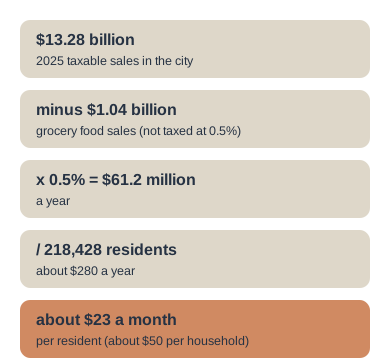
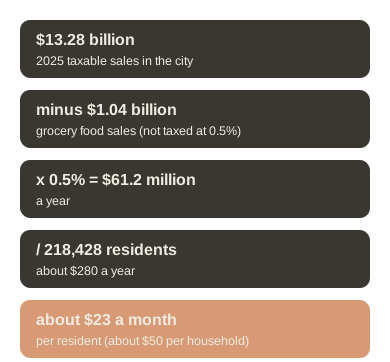
Five steps: $13.28 billion in 2025 taxable sales, minus $1.04 billion in grocery food sales, times 0.5% is $61.2 million a year, divided by 218,428 residents is about $280 a year, or about $23 a month per resident.Five steps: $13.28 billion in 2025 taxable sales, minus $1.04 billion in grocery food sales, times 0.5% is $61.2 million a year, divided by 218,428 residents is about $280 a year, or about $23 a month per resident.
The monthly cost math, from Utah State Tax Commission 2025 taxable sales figures. Chart: Salt Lake City Magazine Limited.

Expect a busy 2027 downtown: the Salt Palace is set to close for about three years starting that fall.

2025 Salt Lake City taxable sales $13,277,092,107 minus grocery food sales $1,038,869,823 = $12,238,222,284; x 0.5% = about $61.2 million a year; divided by 218,428 residents = about $280 a year, about $23 a month per resident; x 2.14 people per household = about $50 a month per household (Utah State Tax Commission; U.S. Census Bureau QuickFacts, both in Sources).

A climbing center with a public plaza, new lights on Main Street and a Sugar House tower: the projects reshaping Salt Lake City

What is being built, and what will you be able to do there?

A climbing center with a public plaza by Central Station, new lights along Main Street, a tower in Sugar House: here is what this year's big city approvals would add to daily life.

These projects moved through city approvals this year. The details come from Planning Commission and Community Reinvestment Agency (CRA) records.
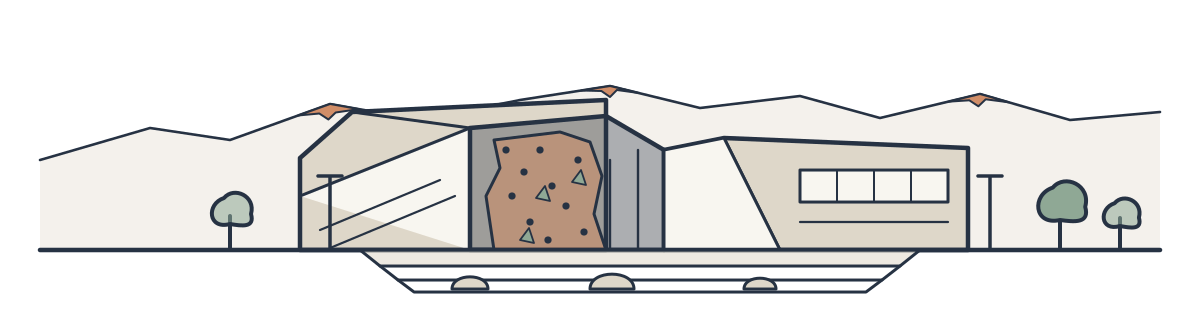
USA Climbing headquarters, 535 W 300 S

Illustration of the planned USA Climbing training center at 300 South and 500 West: a low building of angled silver metal panels with a tall outdoor climbing wall set into its corner, a sunken public plaza with stepped seating in front, and a mountain ridgeline behind.Illustration of the planned USA Climbing training center at 300 South and 500 West: a low building of angled silver metal panels with a tall outdoor climbing wall set into its corner, a sunken public plaza with stepped seating in front, and a mountain ridgeline behind.

USA Climbing, the national governing body for competition climbing, plans a three-story, 99,616-square-foot headquarters and training center next to Central Station, with indoor and outdoor climbing walls, equipment rental and a café opening onto the Woodbine Court arts campus.

Outside, a sunken plaza is designed for 3,500 to 5,000 spectators at climbing events, with seating, play space for children and public art. The planning staff report says: "When not reserved for events, the plaza will be open to the public for daily use."

The design rebuilds the old Salt Lake Mattress Company building with its historic brick. The Planning Commission approved it with conditions on February 11, 2026.

The land belongs to the CRA, which leases it to USA Climbing. In March the CRA board voted 6 to 1 to add $250,000 to its support for the project.
Main Street lights for the Salt Lake Temple reopening

Illustration of Main Street storefronts with new pedestrian-level lampposts topped by small beehive finials, each holding two warm globe lights, and strings of festive lights hung between the posts.Illustration of Main Street storefronts with new pedestrian-level lampposts topped by small beehive finials, each holding two warm globe lights, and strings of festive lights hung between the posts.

The Salt Lake Temple is scheduled to reopen in April 2027 after its seismic renovation, with an open house, according to CRA minutes from March 10, 2026.

To ready Main Street, the CRA backed design of pedestrian-level lampposts and festive lighting from South Temple to 400 South. Board members asked about maintenance and designs that discourage climbing.
A mixed-use tower in Sugar House, 2200 S Highland Dr

Illustration of the planned GEM Sugar House tower: a light-colored tower with dark corner bands and arched windows on its top floor, rising from a glassy parking podium with trees on a pool deck, a bank drive-through canopy at left, and a trail along the front.Illustration of the planned GEM Sugar House tower: a light-colored tower with dark corner bands and arched windows on its top floor, rising from a glassy parking podium with trees on a pool deck, a bank drive-through canopy at left, and a trail along the front.

Gardner Group and Engine 8 proposed a 16-story building with 139 homes, 52 hotel units and about 9,000 square feet of commercial space, including a drive-through bank.

On August 12, 2026, the Planning Commission approved the drive-through bank and the planned development, but denied the open-space change that "would have allowed the additional height," according to the minutes. They do not say how tall the building can now be.

Rebuilding 319 to 323 S Main after the fire

An August 11, 2025, fire destroyed the roof and interior of the building at 319 to 321 S Main, where Los Tapatios and London Belle operated.

Permits show a new four-story building shell at 319. Next door at 323, Whiskey Street is being rebuilt with a second story.

In July the CRA approved a disaster relief loan for the 319 to 321 rebuild, and in August a separate one for Whiskey Street. The permits are in review and inspection.

Homes around the Granary silos

On the block between 500 and 600 South and 400 and 500 West, Blaser Ventures plans affordable and market-rate housing, shops and open space around six grain silos that will stay standing.

The first commercial building, at 522 S 400 W, would hold a dining area, a live music venue and bowling. The Planning Commission approved it on September 9, 2026.

In July the CRA board voted 6 to 1 to approve tax increment terms for the project's first five phases, which include homes restricted to households earning 60% of area median income or less.
Also in the pipeline

Illustration of Rocky Mountain Power's planned 10-story glass headquarters on North Temple, with stepped terraces cut into one side and an open loggia near the top, a TRAX light rail car passing in front and trees at right.Illustration of Rocky Mountain Power's planned 10-story glass headquarters on North Temple, with stepped terraces cut into one side and an open loggia near the top, a TRAX light rail car passing in front and trees at right.
  • Rocky Mountain Power's new 10-story headquarters at 1465 W North Temple, the first building in the Larry H. Miller Company's Power District, now in city building inspections. It topped out in September and is planned to open in 2027.
  • A three-story building with underground parking for Centro Civico Mexicano and Centro de la Familia at 155 S 600 W, in permit review. Peter Corroon, a developer helping with the project, told KSL he hopes work starts by January 2028.

Reported crime in Salt Lake City fell 14.7% in the police department's latest year

How much did crime drop, and what does the police department cost each resident?
Illustration of Salt Lake City's Public Safety Building at 475 S. 300 East: a curved glass wing, a flared solar canopy over the front plaza and a banded four-story wing under a deep roof overhang, with the Wasatch behind.Illustration of Salt Lake City's Public Safety Building at 475 S. 300 East: a curved glass wing, a flared solar canopy over the front plaza and a banded four-story wing under a deep roof overhang, with the Wasatch behind.

Salt Lake City police counted 14.7% less reported crime in their 2026 fiscal year, July 2025 through June 2026, than the year before, according to the department's annual report.

Both big categories fell:
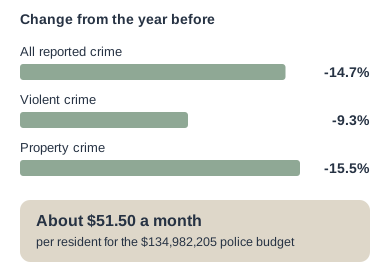
  • violent crime, down 9.3%
  • property crime, down 15.5%
  • homicide, no change from the year before
Bar chart: reported crime fell 14.7% overall, violent crime fell 9.3% and property crime fell 15.5%. Callout: the $134,982,205 police budget is about $51.50 a month per resident.Bar chart: reported crime fell 14.7% overall, violent crime fell 9.3% and property crime fell 15.5%. Callout: the $134,982,205 police budget is about $51.50 a month per resident.
Salt Lake City Police Department annual report, fiscal year 2026 (July 2025 through June 2026), page 11. Chart: Salt Lake City Magazine Limited.

When someone calls with an emergency, the most urgent kind of call, Priority 1, drew an average response of 7 minutes 3 seconds. The department had 644 sworn officers and 155 civilian staff.

What does that cost you? The department's total budget is $134,982,205. Divide by the city's 218,428 residents and you get about $618 a year. Divide by 12 and it is about $51.50 a month per resident.

Visitors and commuters also use police services, so think of that as an average, not a bill. For newer numbers by neighborhood, the department posts a dashboard of preliminary figures.

Explore

At Art Café SLC you order art supplies from a menu, like dinner

How does a restaurant for making art work, and who started it?
Illustration of a table set like dinner at an art café: a flight of three ink bottles on a board, brushes on a plate and watercolors in salt and pepper shakers, under one pendant lamp.Illustration of a table set like dinner at an art café: a flight of three ink bottles on a board, brushes on a plate and watercolors in salt and pepper shakers, under one pendant lamp.

When Madi Nilsson was a kid, she ran summer camps for the neighborhood kids in her parents' backyard: watercolor one day, sewing the next.

Years later, on a trip to London, she wandered into a café that served art projects instead of food, and the idea stuck.

In mid-November 2025 she opened Art Café at 870 E 900 S in the 9th and 9th neighborhood, a few blocks from Salt Lake Pottery Studio, the shop she opened in 2022.

"Everything we did in the summer camps is on the menu," she told the Tribune.

It works like a restaurant.

You get a table and a menu, and you order an "entrée": a flight of ink, a charcoal sampler, an air-dry clay soufflé or a collage buffet.

A server brings the materials and handles the cleanup. A session runs about 90 minutes, and every art experience is $28. You're welcome to bring your own snack and drink.

The café puts it this way: "We believe that you don’t have to be “good” at art to enjoy it." Come solo, on a date, with friends or with kids.

Hours are 4:00 to 10:00 p.m. on weekdays and 11:00 a.m. to 10:00 p.m. on weekends; reservations are on OpenTable through the Art Cafe website

Map

Alta and Solitude plan to open November 20, and Alta parking changes in December

When can you ski, and how will you get up the canyon?

Illustration of the Cottonwood Canyons at the start of ski season: snowy Wasatch peaks, a chairlift climbing the slope, pine trees at the base, and a ski bus on the canyon road.Illustration of the Cottonwood Canyons at the start of ski season: snowy Wasatch peaks, a chairlift climbing the slope, pine trees at the base, and a ski bus on the canyon road.

Late fall is the quiet stretch in Big and Little Cottonwood Canyons, and the next few weeks set up how residents will get up there once the lifts turn.

Alta Ski Area and Solitude Mountain Resort both plan to open on Friday, November 20, conditions permitting. Alta is starting its 89th winter, and Solitude is throwing a DJ and Donuts Opening Party that day.

Parking at Alta changes in December. Starting Friday, December 11, a $25 reservation is required Fridays through Sundays and holiday periods from 8 a.m. to 1 p.m. at the Grizzly, Flagstaff (South Side), Wildcat, and Albion lots, through Sunday, April 4.

Reservations open in mid-October on the Alta parking site, and more are released every Sunday at 3 p.m.
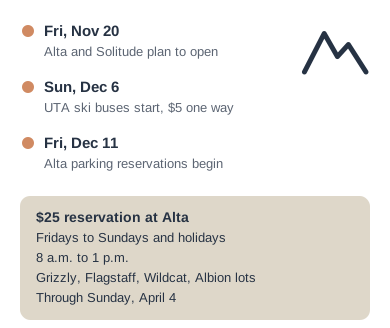
Dates: Alta and Solitude plan to open Friday, November 20; UTA ski buses start Sunday, December 6, at $5 one way; Alta parking reservations begin Friday, December 11. Reservations cost $25, Fridays to Sundays and holidays, 8 a.m. to 1 p.m., at four lots through April 4.Dates: Alta and Solitude plan to open Friday, November 20; UTA ski buses start Sunday, December 6, at $5 one way; Alta parking reservations begin Friday, December 11. Reservations cost $25, Fridays to Sundays and holidays, 8 a.m. to 1 p.m., at four lots through April 4.
Opening dates are conditions permitting. UTA is the Utah Transit Authority, the regional bus and rail agency. Reservations at altaparking.com. Chart: Salt Lake City Magazine Limited.

Get your tires ready before the first storm.

Under the Utah Department of Transportation (UDOT) traction rules for the Cottonwoods, tires need at least 5/32 inch of tread when restrictions are on, and UDOT can put them in place up to 24 hours before a storm. Check live road status.

To skip the drive, use Utah Transit Authority (UTA) ski buses. Seasonal canyon service starts Sunday, December 6, and each one-way ride costs $5, included with resort season passes and Ikon Passes. UTA ski bus details

Finch Lane Gallery opens two new shows on November 2

What opens at Finch Lane on November 2, and what else does the city's Arts Council run from the same desk?
Illustration of the Art Barn in Reservoir Park, home of Finch Lane Gallery: a shingled cottage with a steep dark roof, three gabled dormers, a columned gabled entry with a wooden door, brick chimneys and a lower side wing, between park trees with the Wasatch behind.Illustration of the Art Barn in Reservoir Park, home of Finch Lane Gallery: a shingled cottage with a steep dark roof, three gabled dormers, a columned gabled entry with a wooden door, brick chimneys and a lower side wing, between park trees with the Wasatch behind.
Finch Lane Gallery and Art Barn in Reservoir Park, from above
Finch Lane Gallery, in the historic Art Barn, from above.

Photos courtesy of Salt Lake City Arts Council

Some cities scatter their arts calendar across five tabs you never bookmark.

When: Monday, Wednesday, Thursday and Friday, 9:00 a.m. to 5:00 p.m.; Tuesday, 9:00 a.m. to 8:30 p.m.; closed weekends

Where: Finch Lane Gallery, 54 Finch Lane, in Reservoir Park (Map)

Through October 23, the gallery shows textiles, ceramics and mixed media. Two new shows open November 2 and run through December 18, with an opening reception Friday, November 6, 6:00 to 9:00 p.m.

Salt Lake keeps a clearer door: Finch Lane Gallery in Reservoir Park, where the Salt Lake City Arts Council points neighbors toward gallery shows, outdoor concerts, folk traditions, grants, and public art from one desk.

That is the quiet usefulness of the place. You can walk into Finch Lane Gallery for what is on the walls right now, then follow the same home base out to the Twilight Concert Series, Living Traditions, the Grants program, and public art around town, without treating each program like a separate hunt.

Inside Finch Lane Gallery
Inside the gallery.

Photos courtesy of Salt Lake City Arts Council

Salt Lake City Arts Council website